
Here's a conversation that happens in boardrooms across Australia: the business is growing, the pipeline is full, the team is stretched — and someone says, "We need to hire."
Then the CFO opens a spreadsheet.
A mid-level marketing hire in Melbourne will run you $85,000–$110,000 in base salary before you touch super, annual leave loading, workers' comp, onboarding time, equipment, or the very real chance they're gone in 18 months. A senior developer? Add another $40,000 to that number and a three-month recruitment lag.
Most growing businesses aren't short on ambition. They're short on the right model for resourcing that ambition without blowing the budget before the revenue catches up.
That's exactly where dedicated resources come in — and why more Australian SMEs and scale-ups are rethinking how they build their teams entirely.
What Are Dedicated Resources?
The term gets thrown around a lot, so let's be direct about what it means in practice.
Dedicated resources are professionals — developers, marketers, designers, operations staff, project managers — who work exclusively on your business, under your direction, but are employed and managed through a specialist provider. They're not a freelancer you find on a platform who's juggling six clients at once. They're not a generalist agency running your account between dozens of others.
They're your team. Just not on your payroll.
There are broadly two models worth understanding:
Offshore Dedicated Resources
Your dedicated team is based in a lower-cost talent market like the Philippines and India, but integrated into your workflows, your tools, your culture. Done well, the timezone gap is manageable. Done poorly, it becomes an excuse for poor delivery.
Managed Dedicated Resources
Your provider handles HR, compliance, performance management and infrastructure. You get the output and the relationship. They carry the employment overhead. This is the model that particularly suits businesses that want scale without building an internal people function to support it.
The Real Cost of Hiring in Australia (The Numbers Nobody Puts in the Job Ad)
Let's put some honest figures on the table, because the listed salary is genuinely just the starting point.
For a $90,000 marketing coordinator role in Melbourne, the true annual cost to your business sits closer to $130,000–$145,000 once you account for on-costs, tools, and lost productivity during ramp-up.
Here's where the gap opens up:
- Superannuation: 11.5% on top of base salary
- Annual and personal leave: typically 4–6 weeks of paid non-productive time
- Workers' compensation insurance: 1–2% of payroll depending on industry
- Payroll tax: applies once your Australian wages exceed your state threshold (as low as $700K in some states)
- Recruitment: agency fees run 15–20% of first-year salary; internal recruitment still costs time and advertising spend
- Equipment and software licensing: $3,000–$8,000 upfront per hire
- Onboarding and ramp-up: productivity typically runs at 50–70% for the first 3 months
- Turnover risk: the average Australian employee tenure in digital, marketing and admin roles is under 2.5 years
Now compare that to a dedicated resource model. For a comparable mid-level marketing professional through an offshore dedicated resources arrangement, the monthly investment typically sits between $3,500–$5,500 AUD — fully managed, no super, no leave liability, no recruitment fees.
Annualised, that's $42,000–$66,000 for a role that would cost you $130,000+ locally. The delta is real, and the capability gap, when you work with the right provider, is far smaller than most business owners assume before they try it.
A Scenario Worth Sitting With
Take a Melbourne-based mortgage broking firm. Like most in their space, they were running lean — a small front-of-house team handling client intake, loan processing support, compliance documentation, and general admin. Good people, but expensive to hire locally, hard to retain, and constantly stretched during busy periods.
They came to us not because the business was struggling, but because the principal was tired of the revolving door. Every time someone left, it cost them three months of recruitment, another three months of ramp-up, and a client experience that quietly suffered in between.
They brought on a dedicated offshore admin staff through us, handling loan application coordination, document management, and client follow-up. Client communication turnaround improved, the principal got time back, and the annual saving on having their dedicated support team came in above $60,000 compared to equivalent local hires.
What they'll tell you now isn't just about the cost. It's that the dedicated model brought consistency. The same people, embedded in their process, who actually know the business.
That's what most businesses are really missing when they keep hiring locally and watching people leave.
What Dedicated Resources Let You Do
Beyond the cost argument because for some business owners the cost argument alone isn't enough this model changes what's possible at the growth stage.
- You can staff up for a specific growth phase without locking in permanent overhead
- You can build specialist capability (SEO, paid ads, data analysis, development) that would be out of reach as a local hire at your current revenue
- You can operate across more time zones, which matters in eCommerce, SaaS, and global service businesses
- You can test, fail fast, and reconfigure a team structure without a redundancy conversation and a Fair Work headache
This is what scalable workforce solutions for growing businesses actually look like in practice — not a hiring freeze, not a freelancer patchwork, but a deliberate model for building capability that matches your growth curve.
The Objections (And What's True)
Communication will be a nightmare.
It can be, if the provider doesn't invest in integration. The best dedicated resource arrangements run in your Slack, your project management tools, your weekly standups. We've seen offshore team members who are more engaged and responsive than local hires who were already mentally checking out.
I need someone who understands the Australian market.
For some roles, that's true and local hires remain the right answer for those. For a significant proportion of execution roles in digital marketing, development, design, and operations, the market context can be learned and the skill is transferable. The question worth asking is: does this role need to be local, or do I just assume it does?
I won't have visibility over what they're doing.
With a well-structured managed dedicated resources model, you typically have more visibility than you do over a local hire because output accountability is baked into the engagement from day one. The vague job description that produces vague results doesn't fly.
How to Know If You're Ready to Explore This
You don't need to be a $50M business to make this model work. But there are some indicators that the time is right:
- You're hiring reactively — a role opens, you scramble — rather than building a workforce strategy
- You've identified capability gaps that local recruitment can't fill quickly or affordably
- Your growth rate is outpacing your ability to hire and onboard sustainably
- You're paying for full-time headcount to do part-time workload in specific functions
- You've had turnover in key roles and absorbed the cost more than once
If three or more of those land — it's worth a conversation.
Scale your Team with Elephant in the Boardroom Dedicated Resources
The best-run businesses we work with don't think of dedicated resources as a cost-cutting measure. They think of it as a capability strategy — a deliberate choice about where to invest in local talent versus where to leverage the global talent market intelligently.
The cost of hiring in Australia is high. The cost of getting the model wrong is higher. And the businesses scaling sustainably right now are the ones who figured out that headcount and capability aren't the same thing.
Dedicated resources aren't a workaround. For the right business, at the right stage, they're the right answer.
If you want to understand what that could look like for your team specifically — what roles translate, what the real investment looks like, and what outcomes others in your position have driven — let's talk.
Here's a conversation that happens in boardrooms across Australia: the business is growing, the pipeline is full, the team is stretched — and someone says, "We need to hire."
Then the CFO opens a spreadsheet.
A mid-level marketing hire in Melbourne will run you $85,000–$110,000 in base salary before you touch super, annual leave loading, workers' comp, onboarding time, equipment, or the very real chance they're gone in 18 months. A senior developer? Add another $40,000 to that number and a three-month recruitment lag.
Most growing businesses aren't short on ambition. They're short on the right model for resourcing that ambition without blowing the budget before the revenue catches up.
That's exactly where dedicated resources come in — and why more Australian SMEs and scale-ups are rethinking how they build their teams entirely.
What Are Dedicated Resources?
The term gets thrown around a lot, so let's be direct about what it means in practice.
Dedicated resources are professionals — developers, marketers, designers, operations staff, project managers — who work exclusively on your business, under your direction, but are employed and managed through a specialist provider. They're not a freelancer you find on a platform who's juggling six clients at once. They're not a generalist agency running your account between dozens of others.
They're your team. Just not on your payroll.
There are broadly two models worth understanding:
Offshore Dedicated Resources
Your dedicated team is based in a lower-cost talent market like the Philippines and India, but integrated into your workflows, your tools, your culture. Done well, the timezone gap is manageable. Done poorly, it becomes an excuse for poor delivery.
Managed Dedicated Resources
Your provider handles HR, compliance, performance management and infrastructure. You get the output and the relationship. They carry the employment overhead. This is the model that particularly suits businesses that want scale without building an internal people function to support it.
The Real Cost of Hiring in Australia (The Numbers Nobody Puts in the Job Ad)
Let's put some honest figures on the table, because the listed salary is genuinely just the starting point.
For a $90,000 marketing coordinator role in Melbourne, the true annual cost to your business sits closer to $130,000–$145,000 once you account for on-costs, tools, and lost productivity during ramp-up.
Here's where the gap opens up:
- Superannuation: 11.5% on top of base salary
- Annual and personal leave: typically 4–6 weeks of paid non-productive time
- Workers' compensation insurance: 1–2% of payroll depending on industry
- Payroll tax: applies once your Australian wages exceed your state threshold (as low as $700K in some states)
- Recruitment: agency fees run 15–20% of first-year salary; internal recruitment still costs time and advertising spend
- Equipment and software licensing: $3,000–$8,000 upfront per hire
- Onboarding and ramp-up: productivity typically runs at 50–70% for the first 3 months
- Turnover risk: the average Australian employee tenure in digital, marketing and admin roles is under 2.5 years
Now compare that to a dedicated resource model. For a comparable mid-level marketing professional through an offshore dedicated resources arrangement, the monthly investment typically sits between $3,500–$5,500 AUD — fully managed, no super, no leave liability, no recruitment fees.
Annualised, that's $42,000–$66,000 for a role that would cost you $130,000+ locally. The delta is real, and the capability gap, when you work with the right provider, is far smaller than most business owners assume before they try it.
A Scenario Worth Sitting With
Take a Melbourne-based mortgage broking firm. Like most in their space, they were running lean — a small front-of-house team handling client intake, loan processing support, compliance documentation, and general admin. Good people, but expensive to hire locally, hard to retain, and constantly stretched during busy periods.
They came to us not because the business was struggling, but because the principal was tired of the revolving door. Every time someone left, it cost them three months of recruitment, another three months of ramp-up, and a client experience that quietly suffered in between.
They brought on a dedicated offshore admin staff through us, handling loan application coordination, document management, and client follow-up. Client communication turnaround improved, the principal got time back, and the annual saving on having their dedicated support team came in above $60,000 compared to equivalent local hires.
What they'll tell you now isn't just about the cost. It's that the dedicated model brought consistency. The same people, embedded in their process, who actually know the business.
That's what most businesses are really missing when they keep hiring locally and watching people leave.
What Dedicated Resources Let You Do
Beyond the cost argument because for some business owners the cost argument alone isn't enough this model changes what's possible at the growth stage.
- You can staff up for a specific growth phase without locking in permanent overhead
- You can build specialist capability (SEO, paid ads, data analysis, development) that would be out of reach as a local hire at your current revenue
- You can operate across more time zones, which matters in eCommerce, SaaS, and global service businesses
- You can test, fail fast, and reconfigure a team structure without a redundancy conversation and a Fair Work headache
This is what scalable workforce solutions for growing businesses actually look like in practice — not a hiring freeze, not a freelancer patchwork, but a deliberate model for building capability that matches your growth curve.
The Objections (And What's True)
Communication will be a nightmare.
It can be, if the provider doesn't invest in integration. The best dedicated resource arrangements run in your Slack, your project management tools, your weekly standups. We've seen offshore team members who are more engaged and responsive than local hires who were already mentally checking out.
I need someone who understands the Australian market.
For some roles, that's true and local hires remain the right answer for those. For a significant proportion of execution roles in digital marketing, development, design, and operations, the market context can be learned and the skill is transferable. The question worth asking is: does this role need to be local, or do I just assume it does?
I won't have visibility over what they're doing.
With a well-structured managed dedicated resources model, you typically have more visibility than you do over a local hire because output accountability is baked into the engagement from day one. The vague job description that produces vague results doesn't fly.
How to Know If You're Ready to Explore This
You don't need to be a $50M business to make this model work. But there are some indicators that the time is right:
- You're hiring reactively — a role opens, you scramble — rather than building a workforce strategy
- You've identified capability gaps that local recruitment can't fill quickly or affordably
- Your growth rate is outpacing your ability to hire and onboard sustainably
- You're paying for full-time headcount to do part-time workload in specific functions
- You've had turnover in key roles and absorbed the cost more than once
If three or more of those land — it's worth a conversation.
Scale your Team with Elephant in the Boardroom Dedicated Resources
The best-run businesses we work with don't think of dedicated resources as a cost-cutting measure. They think of it as a capability strategy — a deliberate choice about where to invest in local talent versus where to leverage the global talent market intelligently.
The cost of hiring in Australia is high. The cost of getting the model wrong is higher. And the businesses scaling sustainably right now are the ones who figured out that headcount and capability aren't the same thing.
Dedicated resources aren't a workaround. For the right business, at the right stage, they're the right answer.
If you want to understand what that could look like for your team specifically — what roles translate, what the real investment looks like, and what outcomes others in your position have driven — let's talk.
Here's a conversation that happens in boardrooms across Australia: the business is growing, the pipeline is full, the team is stretched — and someone says, "We need to hire."
Then the CFO opens a spreadsheet.
A mid-level marketing hire in Melbourne will run you $85,000–$110,000 in base salary before you touch super, annual leave loading, workers' comp, onboarding time, equipment, or the very real chance they're gone in 18 months. A senior developer? Add another $40,000 to that number and a three-month recruitment lag.
Most growing businesses aren't short on ambition. They're short on the right model for resourcing that ambition without blowing the budget before the revenue catches up.
That's exactly where dedicated resources come in — and why more Australian SMEs and scale-ups are rethinking how they build their teams entirely.
What Are Dedicated Resources?
The term gets thrown around a lot, so let's be direct about what it means in practice.
Dedicated resources are professionals — developers, marketers, designers, operations staff, project managers — who work exclusively on your business, under your direction, but are employed and managed through a specialist provider. They're not a freelancer you find on a platform who's juggling six clients at once. They're not a generalist agency running your account between dozens of others.
They're your team. Just not on your payroll.
There are broadly two models worth understanding:
Offshore Dedicated Resources
Your dedicated team is based in a lower-cost talent market like the Philippines and India, but integrated into your workflows, your tools, your culture. Done well, the timezone gap is manageable. Done poorly, it becomes an excuse for poor delivery.
Managed Dedicated Resources
Your provider handles HR, compliance, performance management and infrastructure. You get the output and the relationship. They carry the employment overhead. This is the model that particularly suits businesses that want scale without building an internal people function to support it.
The Real Cost of Hiring in Australia (The Numbers Nobody Puts in the Job Ad)
Let's put some honest figures on the table, because the listed salary is genuinely just the starting point.
For a $90,000 marketing coordinator role in Melbourne, the true annual cost to your business sits closer to $130,000–$145,000 once you account for on-costs, tools, and lost productivity during ramp-up.
Here's where the gap opens up:
- Superannuation: 11.5% on top of base salary
- Annual and personal leave: typically 4–6 weeks of paid non-productive time
- Workers' compensation insurance: 1–2% of payroll depending on industry
- Payroll tax: applies once your Australian wages exceed your state threshold (as low as $700K in some states)
- Recruitment: agency fees run 15–20% of first-year salary; internal recruitment still costs time and advertising spend
- Equipment and software licensing: $3,000–$8,000 upfront per hire
- Onboarding and ramp-up: productivity typically runs at 50–70% for the first 3 months
- Turnover risk: the average Australian employee tenure in digital, marketing and admin roles is under 2.5 years
Now compare that to a dedicated resource model. For a comparable mid-level marketing professional through an offshore dedicated resources arrangement, the monthly investment typically sits between $3,500–$5,500 AUD — fully managed, no super, no leave liability, no recruitment fees.
Annualised, that's $42,000–$66,000 for a role that would cost you $130,000+ locally. The delta is real, and the capability gap, when you work with the right provider, is far smaller than most business owners assume before they try it.
A Scenario Worth Sitting With
Take a Melbourne-based mortgage broking firm. Like most in their space, they were running lean — a small front-of-house team handling client intake, loan processing support, compliance documentation, and general admin. Good people, but expensive to hire locally, hard to retain, and constantly stretched during busy periods.
They came to us not because the business was struggling, but because the principal was tired of the revolving door. Every time someone left, it cost them three months of recruitment, another three months of ramp-up, and a client experience that quietly suffered in between.
They brought on a dedicated offshore admin staff through us, handling loan application coordination, document management, and client follow-up. Client communication turnaround improved, the principal got time back, and the annual saving on having their dedicated support team came in above $60,000 compared to equivalent local hires.
What they'll tell you now isn't just about the cost. It's that the dedicated model brought consistency. The same people, embedded in their process, who actually know the business.
That's what most businesses are really missing when they keep hiring locally and watching people leave.
What Dedicated Resources Let You Do
Beyond the cost argument because for some business owners the cost argument alone isn't enough this model changes what's possible at the growth stage.
- You can staff up for a specific growth phase without locking in permanent overhead
- You can build specialist capability (SEO, paid ads, data analysis, development) that would be out of reach as a local hire at your current revenue
- You can operate across more time zones, which matters in eCommerce, SaaS, and global service businesses
- You can test, fail fast, and reconfigure a team structure without a redundancy conversation and a Fair Work headache
This is what scalable workforce solutions for growing businesses actually look like in practice — not a hiring freeze, not a freelancer patchwork, but a deliberate model for building capability that matches your growth curve.
The Objections (And What's True)
Communication will be a nightmare.
It can be, if the provider doesn't invest in integration. The best dedicated resource arrangements run in your Slack, your project management tools, your weekly standups. We've seen offshore team members who are more engaged and responsive than local hires who were already mentally checking out.
I need someone who understands the Australian market.
For some roles, that's true and local hires remain the right answer for those. For a significant proportion of execution roles in digital marketing, development, design, and operations, the market context can be learned and the skill is transferable. The question worth asking is: does this role need to be local, or do I just assume it does?
I won't have visibility over what they're doing.
With a well-structured managed dedicated resources model, you typically have more visibility than you do over a local hire because output accountability is baked into the engagement from day one. The vague job description that produces vague results doesn't fly.
How to Know If You're Ready to Explore This
You don't need to be a $50M business to make this model work. But there are some indicators that the time is right:
- You're hiring reactively — a role opens, you scramble — rather than building a workforce strategy
- You've identified capability gaps that local recruitment can't fill quickly or affordably
- Your growth rate is outpacing your ability to hire and onboard sustainably
- You're paying for full-time headcount to do part-time workload in specific functions
- You've had turnover in key roles and absorbed the cost more than once
If three or more of those land — it's worth a conversation.
Scale your Team with Elephant in the Boardroom Dedicated Resources
The best-run businesses we work with don't think of dedicated resources as a cost-cutting measure. They think of it as a capability strategy — a deliberate choice about where to invest in local talent versus where to leverage the global talent market intelligently.
The cost of hiring in Australia is high. The cost of getting the model wrong is higher. And the businesses scaling sustainably right now are the ones who figured out that headcount and capability aren't the same thing.
Dedicated resources aren't a workaround. For the right business, at the right stage, they're the right answer.
If you want to understand what that could look like for your team specifically — what roles translate, what the real investment looks like, and what outcomes others in your position have driven — let's talk.
Here's a conversation that happens in boardrooms across Australia: the business is growing, the pipeline is full, the team is stretched — and someone says, "We need to hire."
Then the CFO opens a spreadsheet.
A mid-level marketing hire in Melbourne will run you $85,000–$110,000 in base salary before you touch super, annual leave loading, workers' comp, onboarding time, equipment, or the very real chance they're gone in 18 months. A senior developer? Add another $40,000 to that number and a three-month recruitment lag.
Most growing businesses aren't short on ambition. They're short on the right model for resourcing that ambition without blowing the budget before the revenue catches up.
That's exactly where dedicated resources come in — and why more Australian SMEs and scale-ups are rethinking how they build their teams entirely.
What Are Dedicated Resources?
The term gets thrown around a lot, so let's be direct about what it means in practice.
Dedicated resources are professionals — developers, marketers, designers, operations staff, project managers — who work exclusively on your business, under your direction, but are employed and managed through a specialist provider. They're not a freelancer you find on a platform who's juggling six clients at once. They're not a generalist agency running your account between dozens of others.
They're your team. Just not on your payroll.
There are broadly two models worth understanding:
Offshore Dedicated Resources
Your dedicated team is based in a lower-cost talent market like the Philippines and India, but integrated into your workflows, your tools, your culture. Done well, the timezone gap is manageable. Done poorly, it becomes an excuse for poor delivery.
Managed Dedicated Resources
Your provider handles HR, compliance, performance management and infrastructure. You get the output and the relationship. They carry the employment overhead. This is the model that particularly suits businesses that want scale without building an internal people function to support it.
The Real Cost of Hiring in Australia (The Numbers Nobody Puts in the Job Ad)
Let's put some honest figures on the table, because the listed salary is genuinely just the starting point.
For a $90,000 marketing coordinator role in Melbourne, the true annual cost to your business sits closer to $130,000–$145,000 once you account for on-costs, tools, and lost productivity during ramp-up.
Here's where the gap opens up:
- Superannuation: 11.5% on top of base salary
- Annual and personal leave: typically 4–6 weeks of paid non-productive time
- Workers' compensation insurance: 1–2% of payroll depending on industry
- Payroll tax: applies once your Australian wages exceed your state threshold (as low as $700K in some states)
- Recruitment: agency fees run 15–20% of first-year salary; internal recruitment still costs time and advertising spend
- Equipment and software licensing: $3,000–$8,000 upfront per hire
- Onboarding and ramp-up: productivity typically runs at 50–70% for the first 3 months
- Turnover risk: the average Australian employee tenure in digital, marketing and admin roles is under 2.5 years
Now compare that to a dedicated resource model. For a comparable mid-level marketing professional through an offshore dedicated resources arrangement, the monthly investment typically sits between $3,500–$5,500 AUD — fully managed, no super, no leave liability, no recruitment fees.
Annualised, that's $42,000–$66,000 for a role that would cost you $130,000+ locally. The delta is real, and the capability gap, when you work with the right provider, is far smaller than most business owners assume before they try it.
A Scenario Worth Sitting With
Take a Melbourne-based mortgage broking firm. Like most in their space, they were running lean — a small front-of-house team handling client intake, loan processing support, compliance documentation, and general admin. Good people, but expensive to hire locally, hard to retain, and constantly stretched during busy periods.
They came to us not because the business was struggling, but because the principal was tired of the revolving door. Every time someone left, it cost them three months of recruitment, another three months of ramp-up, and a client experience that quietly suffered in between.
They brought on a dedicated offshore admin staff through us, handling loan application coordination, document management, and client follow-up. Client communication turnaround improved, the principal got time back, and the annual saving on having their dedicated support team came in above $60,000 compared to equivalent local hires.
What they'll tell you now isn't just about the cost. It's that the dedicated model brought consistency. The same people, embedded in their process, who actually know the business.
That's what most businesses are really missing when they keep hiring locally and watching people leave.
What Dedicated Resources Let You Do
Beyond the cost argument because for some business owners the cost argument alone isn't enough this model changes what's possible at the growth stage.
- You can staff up for a specific growth phase without locking in permanent overhead
- You can build specialist capability (SEO, paid ads, data analysis, development) that would be out of reach as a local hire at your current revenue
- You can operate across more time zones, which matters in eCommerce, SaaS, and global service businesses
- You can test, fail fast, and reconfigure a team structure without a redundancy conversation and a Fair Work headache
This is what scalable workforce solutions for growing businesses actually look like in practice — not a hiring freeze, not a freelancer patchwork, but a deliberate model for building capability that matches your growth curve.
The Objections (And What's True)
Communication will be a nightmare.
It can be, if the provider doesn't invest in integration. The best dedicated resource arrangements run in your Slack, your project management tools, your weekly standups. We've seen offshore team members who are more engaged and responsive than local hires who were already mentally checking out.
I need someone who understands the Australian market.
For some roles, that's true and local hires remain the right answer for those. For a significant proportion of execution roles in digital marketing, development, design, and operations, the market context can be learned and the skill is transferable. The question worth asking is: does this role need to be local, or do I just assume it does?
I won't have visibility over what they're doing.
With a well-structured managed dedicated resources model, you typically have more visibility than you do over a local hire because output accountability is baked into the engagement from day one. The vague job description that produces vague results doesn't fly.
How to Know If You're Ready to Explore This
You don't need to be a $50M business to make this model work. But there are some indicators that the time is right:
- You're hiring reactively — a role opens, you scramble — rather than building a workforce strategy
- You've identified capability gaps that local recruitment can't fill quickly or affordably
- Your growth rate is outpacing your ability to hire and onboard sustainably
- You're paying for full-time headcount to do part-time workload in specific functions
- You've had turnover in key roles and absorbed the cost more than once
If three or more of those land — it's worth a conversation.
Scale your Team with Elephant in the Boardroom Dedicated Resources
The best-run businesses we work with don't think of dedicated resources as a cost-cutting measure. They think of it as a capability strategy — a deliberate choice about where to invest in local talent versus where to leverage the global talent market intelligently.
The cost of hiring in Australia is high. The cost of getting the model wrong is higher. And the businesses scaling sustainably right now are the ones who figured out that headcount and capability aren't the same thing.
Dedicated resources aren't a workaround. For the right business, at the right stage, they're the right answer.
If you want to understand what that could look like for your team specifically — what roles translate, what the real investment looks like, and what outcomes others in your position have driven — let's talk.
Here's a conversation that happens in boardrooms across Australia: the business is growing, the pipeline is full, the team is stretched — and someone says, "We need to hire."
Then the CFO opens a spreadsheet.
A mid-level marketing hire in Melbourne will run you $85,000–$110,000 in base salary before you touch super, annual leave loading, workers' comp, onboarding time, equipment, or the very real chance they're gone in 18 months. A senior developer? Add another $40,000 to that number and a three-month recruitment lag.
Most growing businesses aren't short on ambition. They're short on the right model for resourcing that ambition without blowing the budget before the revenue catches up.
That's exactly where dedicated resources come in — and why more Australian SMEs and scale-ups are rethinking how they build their teams entirely.
What Are Dedicated Resources?
The term gets thrown around a lot, so let's be direct about what it means in practice.
Dedicated resources are professionals — developers, marketers, designers, operations staff, project managers — who work exclusively on your business, under your direction, but are employed and managed through a specialist provider. They're not a freelancer you find on a platform who's juggling six clients at once. They're not a generalist agency running your account between dozens of others.
They're your team. Just not on your payroll.
There are broadly two models worth understanding:
Offshore Dedicated Resources
Your dedicated team is based in a lower-cost talent market like the Philippines and India, but integrated into your workflows, your tools, your culture. Done well, the timezone gap is manageable. Done poorly, it becomes an excuse for poor delivery.
Managed Dedicated Resources
Your provider handles HR, compliance, performance management and infrastructure. You get the output and the relationship. They carry the employment overhead. This is the model that particularly suits businesses that want scale without building an internal people function to support it.
The Real Cost of Hiring in Australia (The Numbers Nobody Puts in the Job Ad)
Let's put some honest figures on the table, because the listed salary is genuinely just the starting point.
For a $90,000 marketing coordinator role in Melbourne, the true annual cost to your business sits closer to $130,000–$145,000 once you account for on-costs, tools, and lost productivity during ramp-up.
Here's where the gap opens up:
- Superannuation: 11.5% on top of base salary
- Annual and personal leave: typically 4–6 weeks of paid non-productive time
- Workers' compensation insurance: 1–2% of payroll depending on industry
- Payroll tax: applies once your Australian wages exceed your state threshold (as low as $700K in some states)
- Recruitment: agency fees run 15–20% of first-year salary; internal recruitment still costs time and advertising spend
- Equipment and software licensing: $3,000–$8,000 upfront per hire
- Onboarding and ramp-up: productivity typically runs at 50–70% for the first 3 months
- Turnover risk: the average Australian employee tenure in digital, marketing and admin roles is under 2.5 years
Now compare that to a dedicated resource model. For a comparable mid-level marketing professional through an offshore dedicated resources arrangement, the monthly investment typically sits between $3,500–$5,500 AUD — fully managed, no super, no leave liability, no recruitment fees.
Annualised, that's $42,000–$66,000 for a role that would cost you $130,000+ locally. The delta is real, and the capability gap, when you work with the right provider, is far smaller than most business owners assume before they try it.
A Scenario Worth Sitting With
Take a Melbourne-based mortgage broking firm. Like most in their space, they were running lean — a small front-of-house team handling client intake, loan processing support, compliance documentation, and general admin. Good people, but expensive to hire locally, hard to retain, and constantly stretched during busy periods.
They came to us not because the business was struggling, but because the principal was tired of the revolving door. Every time someone left, it cost them three months of recruitment, another three months of ramp-up, and a client experience that quietly suffered in between.
They brought on a dedicated offshore admin staff through us, handling loan application coordination, document management, and client follow-up. Client communication turnaround improved, the principal got time back, and the annual saving on having their dedicated support team came in above $60,000 compared to equivalent local hires.
What they'll tell you now isn't just about the cost. It's that the dedicated model brought consistency. The same people, embedded in their process, who actually know the business.
That's what most businesses are really missing when they keep hiring locally and watching people leave.
What Dedicated Resources Let You Do
Beyond the cost argument because for some business owners the cost argument alone isn't enough this model changes what's possible at the growth stage.
- You can staff up for a specific growth phase without locking in permanent overhead
- You can build specialist capability (SEO, paid ads, data analysis, development) that would be out of reach as a local hire at your current revenue
- You can operate across more time zones, which matters in eCommerce, SaaS, and global service businesses
- You can test, fail fast, and reconfigure a team structure without a redundancy conversation and a Fair Work headache
This is what scalable workforce solutions for growing businesses actually look like in practice — not a hiring freeze, not a freelancer patchwork, but a deliberate model for building capability that matches your growth curve.
The Objections (And What's True)
Communication will be a nightmare.
It can be, if the provider doesn't invest in integration. The best dedicated resource arrangements run in your Slack, your project management tools, your weekly standups. We've seen offshore team members who are more engaged and responsive than local hires who were already mentally checking out.
I need someone who understands the Australian market.
For some roles, that's true and local hires remain the right answer for those. For a significant proportion of execution roles in digital marketing, development, design, and operations, the market context can be learned and the skill is transferable. The question worth asking is: does this role need to be local, or do I just assume it does?
I won't have visibility over what they're doing.
With a well-structured managed dedicated resources model, you typically have more visibility than you do over a local hire because output accountability is baked into the engagement from day one. The vague job description that produces vague results doesn't fly.
How to Know If You're Ready to Explore This
You don't need to be a $50M business to make this model work. But there are some indicators that the time is right:
- You're hiring reactively — a role opens, you scramble — rather than building a workforce strategy
- You've identified capability gaps that local recruitment can't fill quickly or affordably
- Your growth rate is outpacing your ability to hire and onboard sustainably
- You're paying for full-time headcount to do part-time workload in specific functions
- You've had turnover in key roles and absorbed the cost more than once
If three or more of those land — it's worth a conversation.
Scale your Team with Elephant in the Boardroom Dedicated Resources
The best-run businesses we work with don't think of dedicated resources as a cost-cutting measure. They think of it as a capability strategy — a deliberate choice about where to invest in local talent versus where to leverage the global talent market intelligently.
The cost of hiring in Australia is high. The cost of getting the model wrong is higher. And the businesses scaling sustainably right now are the ones who figured out that headcount and capability aren't the same thing.
Dedicated resources aren't a workaround. For the right business, at the right stage, they're the right answer.
If you want to understand what that could look like for your team specifically — what roles translate, what the real investment looks like, and what outcomes others in your position have driven — let's talk.
Here's a conversation that happens in boardrooms across Australia: the business is growing, the pipeline is full, the team is stretched — and someone says, "We need to hire."
Then the CFO opens a spreadsheet.
A mid-level marketing hire in Melbourne will run you $85,000–$110,000 in base salary before you touch super, annual leave loading, workers' comp, onboarding time, equipment, or the very real chance they're gone in 18 months. A senior developer? Add another $40,000 to that number and a three-month recruitment lag.
Most growing businesses aren't short on ambition. They're short on the right model for resourcing that ambition without blowing the budget before the revenue catches up.
That's exactly where dedicated resources come in — and why more Australian SMEs and scale-ups are rethinking how they build their teams entirely.
What Are Dedicated Resources?
The term gets thrown around a lot, so let's be direct about what it means in practice.
Dedicated resources are professionals — developers, marketers, designers, operations staff, project managers — who work exclusively on your business, under your direction, but are employed and managed through a specialist provider. They're not a freelancer you find on a platform who's juggling six clients at once. They're not a generalist agency running your account between dozens of others.
They're your team. Just not on your payroll.
There are broadly two models worth understanding:
Offshore Dedicated Resources
Your dedicated team is based in a lower-cost talent market like the Philippines and India, but integrated into your workflows, your tools, your culture. Done well, the timezone gap is manageable. Done poorly, it becomes an excuse for poor delivery.
Managed Dedicated Resources
Your provider handles HR, compliance, performance management and infrastructure. You get the output and the relationship. They carry the employment overhead. This is the model that particularly suits businesses that want scale without building an internal people function to support it.
The Real Cost of Hiring in Australia (The Numbers Nobody Puts in the Job Ad)
Let's put some honest figures on the table, because the listed salary is genuinely just the starting point.
For a $90,000 marketing coordinator role in Melbourne, the true annual cost to your business sits closer to $130,000–$145,000 once you account for on-costs, tools, and lost productivity during ramp-up.
Here's where the gap opens up:
- Superannuation: 11.5% on top of base salary
- Annual and personal leave: typically 4–6 weeks of paid non-productive time
- Workers' compensation insurance: 1–2% of payroll depending on industry
- Payroll tax: applies once your Australian wages exceed your state threshold (as low as $700K in some states)
- Recruitment: agency fees run 15–20% of first-year salary; internal recruitment still costs time and advertising spend
- Equipment and software licensing: $3,000–$8,000 upfront per hire
- Onboarding and ramp-up: productivity typically runs at 50–70% for the first 3 months
- Turnover risk: the average Australian employee tenure in digital, marketing and admin roles is under 2.5 years
Now compare that to a dedicated resource model. For a comparable mid-level marketing professional through an offshore dedicated resources arrangement, the monthly investment typically sits between $3,500–$5,500 AUD — fully managed, no super, no leave liability, no recruitment fees.
Annualised, that's $42,000–$66,000 for a role that would cost you $130,000+ locally. The delta is real, and the capability gap, when you work with the right provider, is far smaller than most business owners assume before they try it.
A Scenario Worth Sitting With
Take a Melbourne-based mortgage broking firm. Like most in their space, they were running lean — a small front-of-house team handling client intake, loan processing support, compliance documentation, and general admin. Good people, but expensive to hire locally, hard to retain, and constantly stretched during busy periods.
They came to us not because the business was struggling, but because the principal was tired of the revolving door. Every time someone left, it cost them three months of recruitment, another three months of ramp-up, and a client experience that quietly suffered in between.
They brought on a dedicated offshore admin staff through us, handling loan application coordination, document management, and client follow-up. Client communication turnaround improved, the principal got time back, and the annual saving on having their dedicated support team came in above $60,000 compared to equivalent local hires.
What they'll tell you now isn't just about the cost. It's that the dedicated model brought consistency. The same people, embedded in their process, who actually know the business.
That's what most businesses are really missing when they keep hiring locally and watching people leave.
What Dedicated Resources Let You Do
Beyond the cost argument because for some business owners the cost argument alone isn't enough this model changes what's possible at the growth stage.
- You can staff up for a specific growth phase without locking in permanent overhead
- You can build specialist capability (SEO, paid ads, data analysis, development) that would be out of reach as a local hire at your current revenue
- You can operate across more time zones, which matters in eCommerce, SaaS, and global service businesses
- You can test, fail fast, and reconfigure a team structure without a redundancy conversation and a Fair Work headache
This is what scalable workforce solutions for growing businesses actually look like in practice — not a hiring freeze, not a freelancer patchwork, but a deliberate model for building capability that matches your growth curve.
The Objections (And What's True)
Communication will be a nightmare.
It can be, if the provider doesn't invest in integration. The best dedicated resource arrangements run in your Slack, your project management tools, your weekly standups. We've seen offshore team members who are more engaged and responsive than local hires who were already mentally checking out.
I need someone who understands the Australian market.
For some roles, that's true and local hires remain the right answer for those. For a significant proportion of execution roles in digital marketing, development, design, and operations, the market context can be learned and the skill is transferable. The question worth asking is: does this role need to be local, or do I just assume it does?
I won't have visibility over what they're doing.
With a well-structured managed dedicated resources model, you typically have more visibility than you do over a local hire because output accountability is baked into the engagement from day one. The vague job description that produces vague results doesn't fly.
How to Know If You're Ready to Explore This
You don't need to be a $50M business to make this model work. But there are some indicators that the time is right:
- You're hiring reactively — a role opens, you scramble — rather than building a workforce strategy
- You've identified capability gaps that local recruitment can't fill quickly or affordably
- Your growth rate is outpacing your ability to hire and onboard sustainably
- You're paying for full-time headcount to do part-time workload in specific functions
- You've had turnover in key roles and absorbed the cost more than once
If three or more of those land — it's worth a conversation.
Scale your Team with Elephant in the Boardroom Dedicated Resources
The best-run businesses we work with don't think of dedicated resources as a cost-cutting measure. They think of it as a capability strategy — a deliberate choice about where to invest in local talent versus where to leverage the global talent market intelligently.
The cost of hiring in Australia is high. The cost of getting the model wrong is higher. And the businesses scaling sustainably right now are the ones who figured out that headcount and capability aren't the same thing.
Dedicated resources aren't a workaround. For the right business, at the right stage, they're the right answer.
If you want to understand what that could look like for your team specifically — what roles translate, what the real investment looks like, and what outcomes others in your position have driven — let's talk.

Melbourne in 2026 is a tough place to get noticed. Customers are scrolling faster, comparing harder, and trusting fewer businesses at first glance. You can have a great service, solid reviews, and a decent following, yet still get beaten by someone down the road who simply shows up first. And it stings when you realise the businesses winning aren’t always better… they’re just easier to find.
That’s why so many marketing trends are falling flat right now. The hype looks good online, but it doesn’t always bring real enquiries through the door. What’s working is more practical, more local, and built around visibility where it actually counts, especially with local SEO Melbourne. If you’re tired of wasting budget on tactics that feel busy but don’t move the needle, you’ll want to see what’s actually driving results in Melbourne this year.
What’s Inside:
- What’s Actually Driving Results: High-Performing Local Strategies
- How to Measure Local Marketing Success in 2026?
- Elephant in the Boardroom: Trusted Local SEO Melbourne Specialists
What’s Actually Driving Results: High-Performing Local Strategies
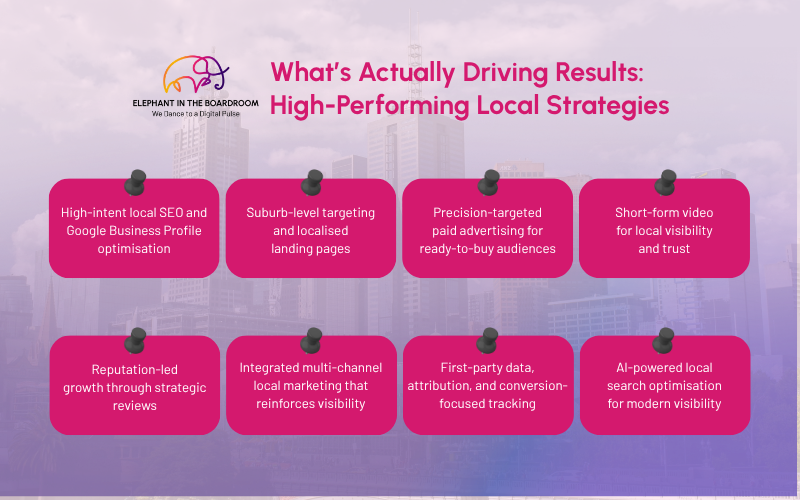
Not all strategies are built for local markets. In a city as competitive as Melbourne, effective local SEO Melbourne requires a more refined, intent-driven approach.
Here’s what’s setting high-performing local businesses apart:
High-Intent Local SEO and Google Business Profile Optimisation
Local SEO in 2026 is about capturing ready-to-act users, not just rankings. Google Business Profile (GBP) sits at the centre, driving calls, visits, and enquiries directly from search, making it a cornerstone of local SEO Melbourne success.
Why this works:
Google prioritises proximity, relevance, and activity, surfacing businesses that are both nearby and actively maintained.
In practice, this means:
- Regularly updating your profile (posts, photos, offers)
- Generating consistent, high-quality reviews
- Responding to reviews to reinforce trust
- Treating GBP as a live conversion channel, not a listing
Suburb-Level Targeting and Localised Landing Pages
Melbourne isn’t one market, it’s a network of micro-markets. Search behaviour in Richmond differs from Brighton, Hawthorn, or Richmond.
Why this works:
Search engines reward geographic relevance, and customers engage more with businesses that clearly operate in their area, making this essential for local SEO Melbourne performance.
In practice, this means:
- Creating suburb-specific landing pages with tailored messaging
- Including local proof (projects, testimonials, landmarks)
- Referencing surrounding suburbs to strengthen relevance
- Avoiding duplicated, template-style content
Precision-Targeted Paid Advertising for Ready-to-Buy Audiences
Paid advertising has shifted from reach to precision, targeting users already in-market and ready to convert.
Why this works:
Modern platforms prioritise intent signals, allowing campaigns to focus spend on high-conversion audiences.
In practice, this means:
- Tight geographic targeting aligned to service areas
- High-intent keywords (e.g. “near me”, “quote”, “same day”)
- Landing pages built specifically for conversion
- Optimisation based on cost-per-lead, not clicks
Short-Form Video for Local Visibility and Trust
Short-form video is now a key discovery channel, often influencing decisions before search even begins.
Why this works:
Video is prioritised by algorithms and builds familiarity and trust faster than static content.
In practice, this means:
- Consistent, informal video content (not overly produced)
- Showcasing real projects, team, and behind-the-scenes
- Creating educational content that answers common questions
- Reinforcing local presence through location-based content
Reputation-Led Growth Through Strategic Reviews
Reviews are no longer secondary, they are a primary driver of both visibility and conversion.
Why this works:
Customers rely heavily on recent, credible feedback, and search platforms use reviews as a ranking signal.
In practice, this means:
- Proactively requesting reviews at key customer moments
- Maintaining a steady flow of recent feedback
- Responding to all reviews to demonstrate engagement
- Using reviews across websites, landing pages, and ads
Integrated Multi-Channel Local Marketing That Reinforces Visibility
No single channel wins alone. Growth comes from channels working together to reinforce visibility and trust.
Why this works:
Customers move across multiple touchpoints before converting. Repetition builds familiarity and confidence.
In practice, this means:
- Aligning SEO, paid ads, and social content
- Maintaining consistent messaging across platforms
- Using retargeting to re-engage interested users
- Creating a seamless journey from discovery to conversion
First-Party Data, Attribution, and Conversion-Focused Tracking
Surface metrics like traffic and impressions no longer reflect true performance, conversion data does.
Why this works:
First-party data provides more accurate insights and enables smarter, revenue-focused decisions.
In practice, this means:
- Tracking calls, form submissions, and enquiries
- Using CRM data to assess lead quality
- Implementing enhanced and server-side tracking
- Measuring success based on cost-per-lead and ROI
AI-Powered Local Search Optimisation for Modern Visibility
Search is evolving beyond traditional rankings. AI now surfaces direct answers, recommendations, and summaries.
Why this works:
AI prioritises clear, structured, and authoritative content when generating responses, reshaping how local SEO Melbourne performs.
In practice, this means:
- Creating content that directly answers customer questions
- Building strong topical authority across services
- Structuring content for clarity and relevance
- Maintaining consistent business information across platforms
How to Measure Local Marketing Success in 2026?
Follower counts do not pay the bills. Neither do impressions nor reach. If you cannot trace marketing activity back to customers and revenue, you are not really measuring success.
Here’s how you can fix that in 2026:
Focus on Revenue-Linked Actions
Forget tracking everything. Focus on actions that lead to sales:
- Phone calls from GBP
- Booking or enquiry forms
- Direction requests to your location
- Online sales from local pages
- Walk-ins linked to campaigns
- If it doesn’t connect to revenue, it’s secondary.
Treat Google Business Profile as Your Main Signal
Your Google Business Profile is often your first impression, so its data matters:
- Calls and website clicks
- Direction requests by suburb
- Review volume and sentiment
- Photo and post engagement
- Consistent reviews now strongly influence local visibility and trust.
Track Visibility Across Search and AI
Customers find businesses through maps, AI results, and voice search. You need to monitor:
- Map pack rankings across Melbourne suburbs
- Brand mentions in AI generated answers
- Visibility compared to local competitors
- Being visible in more than one suburb often matters more than ranking in just one.
Connect Online Activity to Real Customers
Use practical tracking methods:
- Call tracking numbers per campaign
- QR codes for offers or locations
- CRM tagging for lead sources
- Staff asking how customers found you
- This is where marketing gets measurable in real terms.
Pay Attention to Quality, Not Volume
More traffic does not always mean better results. Focus on:
- Lead-to-customer conversion rate
- Enquiry quality by source
- Repeat customers from local channels
- Response time and conversion impact
Use Timing and Location Insights
Local performance shifts across:
- Peak enquiry times
- Suburb-level demand
- Seasonal patterns in Melbourne
- Mobile vs desktop behaviour
Elephant in the Boardroom: Trusted Local SEO Melbourne Specialists
If your local marketing isn’t consistently bringing in the right enquiries, it’s time to fix the part that matters most, and that is how your business shows up when people are actively searching.
That’s exactly where we focus. At Elephant in the Boardroom, we don’t chase traffic for the sake of it. We build local SEO Melbourne strategies that put your business in front of high-intent customers, at the moment they’re ready to act.
We recently partnered with a Melbourne-based professional services firm that had strong brand credibility but inconsistent lead flow. Their visibility didn’t align with how their customers were searching locally, and opportunities were being missed.
We reworked their local SEO strategy with a clear commercial focus:
- Targeting high-intent, location-based keywords that actually drive enquiries
- Restructuring key pages to improve rankings and conversion
- Aligning content with real search behaviour in Melbourne
- Strengthening technical performance to support long-term growth
The result? A consistent increase in qualified leads, stronger rankings where it counts, and a digital presence that actively supports business growth. That’s the standard.
If you’re investing in local SEO marketing services, it should be generating real outcomes: more calls, better enquiries, and a stronger position in your local market. If it’s not, let’s change that.
Book a strategy session with our team today and get a clear view of where your current SEO is falling short, and what it will take to turn it into a reliable growth channel.
Melbourne in 2026 is a tough place to get noticed. Customers are scrolling faster, comparing harder, and trusting fewer businesses at first glance. You can have a great service, solid reviews, and a decent following, yet still get beaten by someone down the road who simply shows up first. And it stings when you realise the businesses winning aren’t always better… they’re just easier to find.
That’s why so many marketing trends are falling flat right now. The hype looks good online, but it doesn’t always bring real enquiries through the door. What’s working is more practical, more local, and built around visibility where it actually counts, especially with local SEO Melbourne. If you’re tired of wasting budget on tactics that feel busy but don’t move the needle, you’ll want to see what’s actually driving results in Melbourne this year.
What’s Inside:
- What’s Actually Driving Results: High-Performing Local Strategies
- How to Measure Local Marketing Success in 2026?
- Elephant in the Boardroom: Trusted Local SEO Melbourne Specialists
What’s Actually Driving Results: High-Performing Local Strategies
Not all strategies are built for local markets. In a city as competitive as Melbourne, effective local SEO Melbourne requires a more refined, intent-driven approach.
Here’s what’s setting high-performing local businesses apart:
High-Intent Local SEO and Google Business Profile Optimisation
Local SEO in 2026 is about capturing ready-to-act users, not just rankings. Google Business Profile (GBP) sits at the centre, driving calls, visits, and enquiries directly from search, making it a cornerstone of local SEO Melbourne success.
Why this works:
Google prioritises proximity, relevance, and activity, surfacing businesses that are both nearby and actively maintained.
In practice, this means:
- Regularly updating your profile (posts, photos, offers)
- Generating consistent, high-quality reviews
- Responding to reviews to reinforce trust
- Treating GBP as a live conversion channel, not a listing
Suburb-Level Targeting and Localised Landing Pages
Melbourne isn’t one market, it’s a network of micro-markets. Search behaviour in Richmond differs from Brighton, Hawthorn, or Richmond.
Why this works:
Search engines reward geographic relevance, and customers engage more with businesses that clearly operate in their area, making this essential for local SEO Melbourne performance.
In practice, this means:
- Creating suburb-specific landing pages with tailored messaging
- Including local proof (projects, testimonials, landmarks)
- Referencing surrounding suburbs to strengthen relevance
- Avoiding duplicated, template-style content
Precision-Targeted Paid Advertising for Ready-to-Buy Audiences
Paid advertising has shifted from reach to precision, targeting users already in-market and ready to convert.
Why this works:
Modern platforms prioritise intent signals, allowing campaigns to focus spend on high-conversion audiences.
In practice, this means:
- Tight geographic targeting aligned to service areas
- High-intent keywords (e.g. “near me”, “quote”, “same day”)
- Landing pages built specifically for conversion
- Optimisation based on cost-per-lead, not clicks
Short-Form Video for Local Visibility and Trust
Short-form video is now a key discovery channel, often influencing decisions before search even begins.
Why this works:
Video is prioritised by algorithms and builds familiarity and trust faster than static content.
In practice, this means:
- Consistent, informal video content (not overly produced)
- Showcasing real projects, team, and behind-the-scenes
- Creating educational content that answers common questions
- Reinforcing local presence through location-based content
Reputation-Led Growth Through Strategic Reviews
Reviews are no longer secondary, they are a primary driver of both visibility and conversion.
Why this works:
Customers rely heavily on recent, credible feedback, and search platforms use reviews as a ranking signal.
In practice, this means:
- Proactively requesting reviews at key customer moments
- Maintaining a steady flow of recent feedback
- Responding to all reviews to demonstrate engagement
- Using reviews across websites, landing pages, and ads
Integrated Multi-Channel Local Marketing That Reinforces Visibility
No single channel wins alone. Growth comes from channels working together to reinforce visibility and trust.
Why this works:
Customers move across multiple touchpoints before converting. Repetition builds familiarity and confidence.
In practice, this means:
- Aligning SEO, paid ads, and social content
- Maintaining consistent messaging across platforms
- Using retargeting to re-engage interested users
- Creating a seamless journey from discovery to conversion
First-Party Data, Attribution, and Conversion-Focused Tracking
Surface metrics like traffic and impressions no longer reflect true performance, conversion data does.
Why this works:
First-party data provides more accurate insights and enables smarter, revenue-focused decisions.
In practice, this means:
- Tracking calls, form submissions, and enquiries
- Using CRM data to assess lead quality
- Implementing enhanced and server-side tracking
- Measuring success based on cost-per-lead and ROI
AI-Powered Local Search Optimisation for Modern Visibility
Search is evolving beyond traditional rankings. AI now surfaces direct answers, recommendations, and summaries.
Why this works:
AI prioritises clear, structured, and authoritative content when generating responses, reshaping how local SEO Melbourne performs.
In practice, this means:
- Creating content that directly answers customer questions
- Building strong topical authority across services
- Structuring content for clarity and relevance
- Maintaining consistent business information across platforms
How to Measure Local Marketing Success in 2026?
Follower counts do not pay the bills. Neither do impressions nor reach. If you cannot trace marketing activity back to customers and revenue, you are not really measuring success.
Here’s how you can fix that in 2026:
Focus on Revenue-Linked Actions
Forget tracking everything. Focus on actions that lead to sales:
- Phone calls from GBP
- Booking or enquiry forms
- Direction requests to your location
- Online sales from local pages
- Walk-ins linked to campaigns
- If it doesn’t connect to revenue, it’s secondary.
Treat Google Business Profile as Your Main Signal
Your Google Business Profile is often your first impression, so its data matters:
- Calls and website clicks
- Direction requests by suburb
- Review volume and sentiment
- Photo and post engagement
- Consistent reviews now strongly influence local visibility and trust.
Track Visibility Across Search and AI
Customers find businesses through maps, AI results, and voice search. You need to monitor:
- Map pack rankings across Melbourne suburbs
- Brand mentions in AI generated answers
- Visibility compared to local competitors
- Being visible in more than one suburb often matters more than ranking in just one.
Connect Online Activity to Real Customers
Use practical tracking methods:
- Call tracking numbers per campaign
- QR codes for offers or locations
- CRM tagging for lead sources
- Staff asking how customers found you
- This is where marketing gets measurable in real terms.
Pay Attention to Quality, Not Volume
More traffic does not always mean better results. Focus on:
- Lead-to-customer conversion rate
- Enquiry quality by source
- Repeat customers from local channels
- Response time and conversion impact
Use Timing and Location Insights
Local performance shifts across:
- Peak enquiry times
- Suburb-level demand
- Seasonal patterns in Melbourne
- Mobile vs desktop behaviour
Elephant in the Boardroom: Trusted Local SEO Melbourne Specialists
If your local marketing isn’t consistently bringing in the right enquiries, it’s time to fix the part that matters most, and that is how your business shows up when people are actively searching.
That’s exactly where we focus. At Elephant in the Boardroom, we don’t chase traffic for the sake of it. We build local SEO Melbourne strategies that put your business in front of high-intent customers, at the moment they’re ready to act.
We recently partnered with a Melbourne-based professional services firm that had strong brand credibility but inconsistent lead flow. Their visibility didn’t align with how their customers were searching locally, and opportunities were being missed.
We reworked their local SEO strategy with a clear commercial focus:
- Targeting high-intent, location-based keywords that actually drive enquiries
- Restructuring key pages to improve rankings and conversion
- Aligning content with real search behaviour in Melbourne
- Strengthening technical performance to support long-term growth
The result? A consistent increase in qualified leads, stronger rankings where it counts, and a digital presence that actively supports business growth. That’s the standard.
If you’re investing in local SEO marketing services, it should be generating real outcomes: more calls, better enquiries, and a stronger position in your local market. If it’s not, let’s change that.
Book a strategy session with our team today and get a clear view of where your current SEO is falling short, and what it will take to turn it into a reliable growth channel.
Melbourne in 2026 is a tough place to get noticed. Customers are scrolling faster, comparing harder, and trusting fewer businesses at first glance. You can have a great service, solid reviews, and a decent following, yet still get beaten by someone down the road who simply shows up first. And it stings when you realise the businesses winning aren’t always better… they’re just easier to find.
That’s why so many marketing trends are falling flat right now. The hype looks good online, but it doesn’t always bring real enquiries through the door. What’s working is more practical, more local, and built around visibility where it actually counts, especially with local SEO Melbourne. If you’re tired of wasting budget on tactics that feel busy but don’t move the needle, you’ll want to see what’s actually driving results in Melbourne this year.
What’s Inside:
- What’s Actually Driving Results: High-Performing Local Strategies
- How to Measure Local Marketing Success in 2026?
- Elephant in the Boardroom: Trusted Local SEO Melbourne Specialists
What’s Actually Driving Results: High-Performing Local Strategies
Not all strategies are built for local markets. In a city as competitive as Melbourne, effective local SEO Melbourne requires a more refined, intent-driven approach.
Here’s what’s setting high-performing local businesses apart:
High-Intent Local SEO and Google Business Profile Optimisation
Local SEO in 2026 is about capturing ready-to-act users, not just rankings. Google Business Profile (GBP) sits at the centre, driving calls, visits, and enquiries directly from search, making it a cornerstone of local SEO Melbourne success.
Why this works:
Google prioritises proximity, relevance, and activity, surfacing businesses that are both nearby and actively maintained.
In practice, this means:
- Regularly updating your profile (posts, photos, offers)
- Generating consistent, high-quality reviews
- Responding to reviews to reinforce trust
- Treating GBP as a live conversion channel, not a listing
Suburb-Level Targeting and Localised Landing Pages
Melbourne isn’t one market, it’s a network of micro-markets. Search behaviour in Richmond differs from Brighton, Hawthorn, or Richmond.
Why this works:
Search engines reward geographic relevance, and customers engage more with businesses that clearly operate in their area, making this essential for local SEO Melbourne performance.
In practice, this means:
- Creating suburb-specific landing pages with tailored messaging
- Including local proof (projects, testimonials, landmarks)
- Referencing surrounding suburbs to strengthen relevance
- Avoiding duplicated, template-style content
Precision-Targeted Paid Advertising for Ready-to-Buy Audiences
Paid advertising has shifted from reach to precision, targeting users already in-market and ready to convert.
Why this works:
Modern platforms prioritise intent signals, allowing campaigns to focus spend on high-conversion audiences.
In practice, this means:
- Tight geographic targeting aligned to service areas
- High-intent keywords (e.g. “near me”, “quote”, “same day”)
- Landing pages built specifically for conversion
- Optimisation based on cost-per-lead, not clicks
Short-Form Video for Local Visibility and Trust
Short-form video is now a key discovery channel, often influencing decisions before search even begins.
Why this works:
Video is prioritised by algorithms and builds familiarity and trust faster than static content.
In practice, this means:
- Consistent, informal video content (not overly produced)
- Showcasing real projects, team, and behind-the-scenes
- Creating educational content that answers common questions
- Reinforcing local presence through location-based content
Reputation-Led Growth Through Strategic Reviews
Reviews are no longer secondary, they are a primary driver of both visibility and conversion.
Why this works:
Customers rely heavily on recent, credible feedback, and search platforms use reviews as a ranking signal.
In practice, this means:
- Proactively requesting reviews at key customer moments
- Maintaining a steady flow of recent feedback
- Responding to all reviews to demonstrate engagement
- Using reviews across websites, landing pages, and ads
Integrated Multi-Channel Local Marketing That Reinforces Visibility
No single channel wins alone. Growth comes from channels working together to reinforce visibility and trust.
Why this works:
Customers move across multiple touchpoints before converting. Repetition builds familiarity and confidence.
In practice, this means:
- Aligning SEO, paid ads, and social content
- Maintaining consistent messaging across platforms
- Using retargeting to re-engage interested users
- Creating a seamless journey from discovery to conversion
First-Party Data, Attribution, and Conversion-Focused Tracking
Surface metrics like traffic and impressions no longer reflect true performance, conversion data does.
Why this works:
First-party data provides more accurate insights and enables smarter, revenue-focused decisions.
In practice, this means:
- Tracking calls, form submissions, and enquiries
- Using CRM data to assess lead quality
- Implementing enhanced and server-side tracking
- Measuring success based on cost-per-lead and ROI
AI-Powered Local Search Optimisation for Modern Visibility
Search is evolving beyond traditional rankings. AI now surfaces direct answers, recommendations, and summaries.
Why this works:
AI prioritises clear, structured, and authoritative content when generating responses, reshaping how local SEO Melbourne performs.
In practice, this means:
- Creating content that directly answers customer questions
- Building strong topical authority across services
- Structuring content for clarity and relevance
- Maintaining consistent business information across platforms
How to Measure Local Marketing Success in 2026?
Follower counts do not pay the bills. Neither do impressions nor reach. If you cannot trace marketing activity back to customers and revenue, you are not really measuring success.
Here’s how you can fix that in 2026:
Focus on Revenue-Linked Actions
Forget tracking everything. Focus on actions that lead to sales:
- Phone calls from GBP
- Booking or enquiry forms
- Direction requests to your location
- Online sales from local pages
- Walk-ins linked to campaigns
- If it doesn’t connect to revenue, it’s secondary.
Treat Google Business Profile as Your Main Signal
Your Google Business Profile is often your first impression, so its data matters:
- Calls and website clicks
- Direction requests by suburb
- Review volume and sentiment
- Photo and post engagement
- Consistent reviews now strongly influence local visibility and trust.
Track Visibility Across Search and AI
Customers find businesses through maps, AI results, and voice search. You need to monitor:
- Map pack rankings across Melbourne suburbs
- Brand mentions in AI generated answers
- Visibility compared to local competitors
- Being visible in more than one suburb often matters more than ranking in just one.
Connect Online Activity to Real Customers
Use practical tracking methods:
- Call tracking numbers per campaign
- QR codes for offers or locations
- CRM tagging for lead sources
- Staff asking how customers found you
- This is where marketing gets measurable in real terms.
Pay Attention to Quality, Not Volume
More traffic does not always mean better results. Focus on:
- Lead-to-customer conversion rate
- Enquiry quality by source
- Repeat customers from local channels
- Response time and conversion impact
Use Timing and Location Insights
Local performance shifts across:
- Peak enquiry times
- Suburb-level demand
- Seasonal patterns in Melbourne
- Mobile vs desktop behaviour
Elephant in the Boardroom: Trusted Local SEO Melbourne Specialists
If your local marketing isn’t consistently bringing in the right enquiries, it’s time to fix the part that matters most, and that is how your business shows up when people are actively searching.
That’s exactly where we focus. At Elephant in the Boardroom, we don’t chase traffic for the sake of it. We build local SEO Melbourne strategies that put your business in front of high-intent customers, at the moment they’re ready to act.
We recently partnered with a Melbourne-based professional services firm that had strong brand credibility but inconsistent lead flow. Their visibility didn’t align with how their customers were searching locally, and opportunities were being missed.
We reworked their local SEO strategy with a clear commercial focus:
- Targeting high-intent, location-based keywords that actually drive enquiries
- Restructuring key pages to improve rankings and conversion
- Aligning content with real search behaviour in Melbourne
- Strengthening technical performance to support long-term growth
The result? A consistent increase in qualified leads, stronger rankings where it counts, and a digital presence that actively supports business growth. That’s the standard.
If you’re investing in local SEO marketing services, it should be generating real outcomes: more calls, better enquiries, and a stronger position in your local market. If it’s not, let’s change that.
Book a strategy session with our team today and get a clear view of where your current SEO is falling short, and what it will take to turn it into a reliable growth channel.
Melbourne in 2026 is a tough place to get noticed. Customers are scrolling faster, comparing harder, and trusting fewer businesses at first glance. You can have a great service, solid reviews, and a decent following, yet still get beaten by someone down the road who simply shows up first. And it stings when you realise the businesses winning aren’t always better… they’re just easier to find.
That’s why so many marketing trends are falling flat right now. The hype looks good online, but it doesn’t always bring real enquiries through the door. What’s working is more practical, more local, and built around visibility where it actually counts, especially with local SEO Melbourne. If you’re tired of wasting budget on tactics that feel busy but don’t move the needle, you’ll want to see what’s actually driving results in Melbourne this year.
What’s Inside:
- What’s Actually Driving Results: High-Performing Local Strategies
- How to Measure Local Marketing Success in 2026?
- Elephant in the Boardroom: Trusted Local SEO Melbourne Specialists
What’s Actually Driving Results: High-Performing Local Strategies
Not all strategies are built for local markets. In a city as competitive as Melbourne, effective local SEO Melbourne requires a more refined, intent-driven approach.
Here’s what’s setting high-performing local businesses apart:
High-Intent Local SEO and Google Business Profile Optimisation
Local SEO in 2026 is about capturing ready-to-act users, not just rankings. Google Business Profile (GBP) sits at the centre, driving calls, visits, and enquiries directly from search, making it a cornerstone of local SEO Melbourne success.
Why this works:
Google prioritises proximity, relevance, and activity, surfacing businesses that are both nearby and actively maintained.
In practice, this means:
- Regularly updating your profile (posts, photos, offers)
- Generating consistent, high-quality reviews
- Responding to reviews to reinforce trust
- Treating GBP as a live conversion channel, not a listing
Suburb-Level Targeting and Localised Landing Pages
Melbourne isn’t one market, it’s a network of micro-markets. Search behaviour in Richmond differs from Brighton, Hawthorn, or Richmond.
Why this works:
Search engines reward geographic relevance, and customers engage more with businesses that clearly operate in their area, making this essential for local SEO Melbourne performance.
In practice, this means:
- Creating suburb-specific landing pages with tailored messaging
- Including local proof (projects, testimonials, landmarks)
- Referencing surrounding suburbs to strengthen relevance
- Avoiding duplicated, template-style content
Precision-Targeted Paid Advertising for Ready-to-Buy Audiences
Paid advertising has shifted from reach to precision, targeting users already in-market and ready to convert.
Why this works:
Modern platforms prioritise intent signals, allowing campaigns to focus spend on high-conversion audiences.
In practice, this means:
- Tight geographic targeting aligned to service areas
- High-intent keywords (e.g. “near me”, “quote”, “same day”)
- Landing pages built specifically for conversion
- Optimisation based on cost-per-lead, not clicks
Short-Form Video for Local Visibility and Trust
Short-form video is now a key discovery channel, often influencing decisions before search even begins.
Why this works:
Video is prioritised by algorithms and builds familiarity and trust faster than static content.
In practice, this means:
- Consistent, informal video content (not overly produced)
- Showcasing real projects, team, and behind-the-scenes
- Creating educational content that answers common questions
- Reinforcing local presence through location-based content
Reputation-Led Growth Through Strategic Reviews
Reviews are no longer secondary, they are a primary driver of both visibility and conversion.
Why this works:
Customers rely heavily on recent, credible feedback, and search platforms use reviews as a ranking signal.
In practice, this means:
- Proactively requesting reviews at key customer moments
- Maintaining a steady flow of recent feedback
- Responding to all reviews to demonstrate engagement
- Using reviews across websites, landing pages, and ads
Integrated Multi-Channel Local Marketing That Reinforces Visibility
No single channel wins alone. Growth comes from channels working together to reinforce visibility and trust.
Why this works:
Customers move across multiple touchpoints before converting. Repetition builds familiarity and confidence.
In practice, this means:
- Aligning SEO, paid ads, and social content
- Maintaining consistent messaging across platforms
- Using retargeting to re-engage interested users
- Creating a seamless journey from discovery to conversion
First-Party Data, Attribution, and Conversion-Focused Tracking
Surface metrics like traffic and impressions no longer reflect true performance, conversion data does.
Why this works:
First-party data provides more accurate insights and enables smarter, revenue-focused decisions.
In practice, this means:
- Tracking calls, form submissions, and enquiries
- Using CRM data to assess lead quality
- Implementing enhanced and server-side tracking
- Measuring success based on cost-per-lead and ROI
AI-Powered Local Search Optimisation for Modern Visibility
Search is evolving beyond traditional rankings. AI now surfaces direct answers, recommendations, and summaries.
Why this works:
AI prioritises clear, structured, and authoritative content when generating responses, reshaping how local SEO Melbourne performs.
In practice, this means:
- Creating content that directly answers customer questions
- Building strong topical authority across services
- Structuring content for clarity and relevance
- Maintaining consistent business information across platforms
How to Measure Local Marketing Success in 2026?
Follower counts do not pay the bills. Neither do impressions nor reach. If you cannot trace marketing activity back to customers and revenue, you are not really measuring success.
Here’s how you can fix that in 2026:
Focus on Revenue-Linked Actions
Forget tracking everything. Focus on actions that lead to sales:
- Phone calls from GBP
- Booking or enquiry forms
- Direction requests to your location
- Online sales from local pages
- Walk-ins linked to campaigns
- If it doesn’t connect to revenue, it’s secondary.
Treat Google Business Profile as Your Main Signal
Your Google Business Profile is often your first impression, so its data matters:
- Calls and website clicks
- Direction requests by suburb
- Review volume and sentiment
- Photo and post engagement
- Consistent reviews now strongly influence local visibility and trust.
Track Visibility Across Search and AI
Customers find businesses through maps, AI results, and voice search. You need to monitor:
- Map pack rankings across Melbourne suburbs
- Brand mentions in AI generated answers
- Visibility compared to local competitors
- Being visible in more than one suburb often matters more than ranking in just one.
Connect Online Activity to Real Customers
Use practical tracking methods:
- Call tracking numbers per campaign
- QR codes for offers or locations
- CRM tagging for lead sources
- Staff asking how customers found you
- This is where marketing gets measurable in real terms.
Pay Attention to Quality, Not Volume
More traffic does not always mean better results. Focus on:
- Lead-to-customer conversion rate
- Enquiry quality by source
- Repeat customers from local channels
- Response time and conversion impact
Use Timing and Location Insights
Local performance shifts across:
- Peak enquiry times
- Suburb-level demand
- Seasonal patterns in Melbourne
- Mobile vs desktop behaviour
Elephant in the Boardroom: Trusted Local SEO Melbourne Specialists
If your local marketing isn’t consistently bringing in the right enquiries, it’s time to fix the part that matters most, and that is how your business shows up when people are actively searching.
That’s exactly where we focus. At Elephant in the Boardroom, we don’t chase traffic for the sake of it. We build local SEO Melbourne strategies that put your business in front of high-intent customers, at the moment they’re ready to act.
We recently partnered with a Melbourne-based professional services firm that had strong brand credibility but inconsistent lead flow. Their visibility didn’t align with how their customers were searching locally, and opportunities were being missed.
We reworked their local SEO strategy with a clear commercial focus:
- Targeting high-intent, location-based keywords that actually drive enquiries
- Restructuring key pages to improve rankings and conversion
- Aligning content with real search behaviour in Melbourne
- Strengthening technical performance to support long-term growth
The result? A consistent increase in qualified leads, stronger rankings where it counts, and a digital presence that actively supports business growth. That’s the standard.
If you’re investing in local SEO marketing services, it should be generating real outcomes: more calls, better enquiries, and a stronger position in your local market. If it’s not, let’s change that.
Book a strategy session with our team today and get a clear view of where your current SEO is falling short, and what it will take to turn it into a reliable growth channel.







4.4 rating from 30 Google reviews