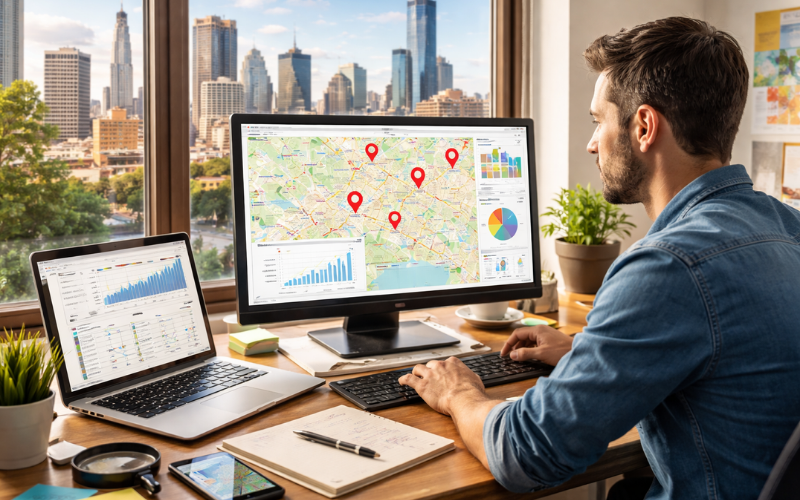
Melbourne in 2026 is a tough place to get noticed. Customers are scrolling faster, comparing harder, and trusting fewer businesses at first glance. You can have a great service, solid reviews, and a decent following, yet still get beaten by someone down the road who simply shows up first. And it stings when you realise the businesses winning aren’t always better… they’re just easier to find.
That’s why so many marketing trends are falling flat right now. The hype looks good online, but it doesn’t always bring real enquiries through the door. What’s working is more practical, more local, and built around visibility where it actually counts, especially with local SEO Melbourne. If you’re tired of wasting budget on tactics that feel busy but don’t move the needle, you’ll want to see what’s actually driving results in Melbourne this year.
What’s Inside:
- What’s Actually Driving Results: High-Performing Local Strategies
- How to Measure Local Marketing Success in 2026?
- Elephant in the Boardroom: Trusted Local SEO Melbourne Specialists
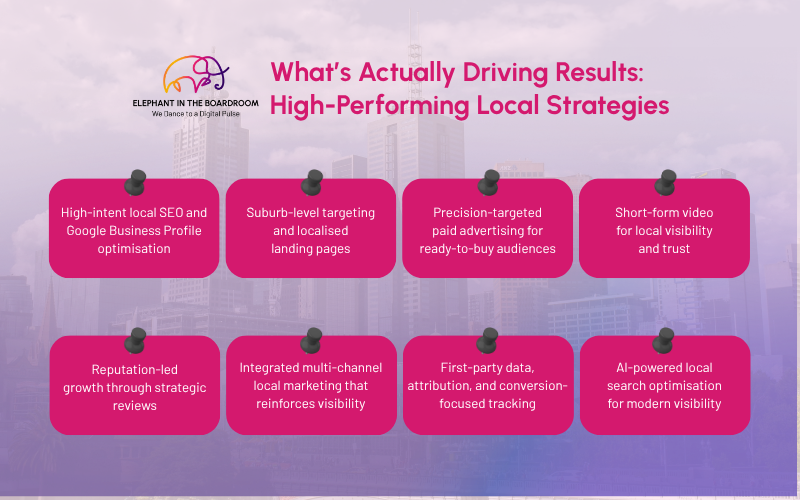
What’s Actually Driving Results: High-Performing Local Strategies
Not all strategies are built for local markets. In a city as competitive as Melbourne, effective local SEO Melbourne requires a more refined, intent-driven approach.
Here’s what’s setting high-performing local businesses apart:
High-Intent Local SEO and Google Business Profile Optimisation
Local SEO in 2026 is about capturing ready-to-act users, not just rankings. Google Business Profile (GBP) sits at the centre, driving calls, visits, and enquiries directly from search, making it a cornerstone of local SEO Melbourne success.
Why this works:
Google prioritises proximity, relevance, and activity, surfacing businesses that are both nearby and actively maintained.
In practice, this means:
- Regularly updating your profile (posts, photos, offers)
- Generating consistent, high-quality reviews
- Responding to reviews to reinforce trust
- Treating GBP as a live conversion channel, not a listing
Suburb-Level Targeting and Localised Landing Pages
Melbourne isn’t one market, it’s a network of micro-markets. Search behaviour in Richmond differs from Brighton, Hawthorn, or Richmond.
Why this works:
Search engines reward geographic relevance, and customers engage more with businesses that clearly operate in their area, making this essential for local SEO Melbourne performance.
In practice, this means:
- Creating suburb-specific landing pages with tailored messaging
- Including local proof (projects, testimonials, landmarks)
- Referencing surrounding suburbs to strengthen relevance
- Avoiding duplicated, template-style content
Precision-Targeted Paid Advertising for Ready-to-Buy Audiences
Paid advertising has shifted from reach to precision, targeting users already in-market and ready to convert.
Why this works:
Modern platforms prioritise intent signals, allowing campaigns to focus spend on high-conversion audiences.
In practice, this means:
- Tight geographic targeting aligned to service areas
- High-intent keywords (e.g. “near me”, “quote”, “same day”)
- Landing pages built specifically for conversion
- Optimisation based on cost-per-lead, not clicks
Short-Form Video for Local Visibility and Trust
Short-form video is now a key discovery channel, often influencing decisions before search even begins.
Why this works:
Video is prioritised by algorithms and builds familiarity and trust faster than static content.
In practice, this means:
- Consistent, informal video content (not overly produced)
- Showcasing real projects, team, and behind-the-scenes
- Creating educational content that answers common questions
- Reinforcing local presence through location-based content
Reputation-Led Growth Through Strategic Reviews
Reviews are no longer secondary, they are a primary driver of both visibility and conversion.
Why this works:
Customers rely heavily on recent, credible feedback, and search platforms use reviews as a ranking signal.
In practice, this means:
- Proactively requesting reviews at key customer moments
- Maintaining a steady flow of recent feedback
- Responding to all reviews to demonstrate engagement
- Using reviews across websites, landing pages, and ads
Integrated Multi-Channel Local Marketing That Reinforces Visibility
No single channel wins alone. Growth comes from channels working together to reinforce visibility and trust.
Why this works:
Customers move across multiple touchpoints before converting. Repetition builds familiarity and confidence.
In practice, this means:
- Aligning SEO, paid ads, and social content
- Maintaining consistent messaging across platforms
- Using retargeting to re-engage interested users
- Creating a seamless journey from discovery to conversion
First-Party Data, Attribution, and Conversion-Focused Tracking
Surface metrics like traffic and impressions no longer reflect true performance, conversion data does.
Why this works:
First-party data provides more accurate insights and enables smarter, revenue-focused decisions.
In practice, this means:
- Tracking calls, form submissions, and enquiries
- Using CRM data to assess lead quality
- Implementing enhanced and server-side tracking
- Measuring success based on cost-per-lead and ROI
AI-Powered Local Search Optimisation for Modern Visibility
Search is evolving beyond traditional rankings. AI now surfaces direct answers, recommendations, and summaries.
Why this works:
AI prioritises clear, structured, and authoritative content when generating responses, reshaping how local SEO Melbourne performs.
In practice, this means:
- Creating content that directly answers customer questions
- Building strong topical authority across services
- Structuring content for clarity and relevance
- Maintaining consistent business information across platforms
How to Measure Local Marketing Success in 2026?
Follower counts do not pay the bills. Neither do impressions nor reach. If you cannot trace marketing activity back to customers and revenue, you are not really measuring success.
Here’s how you can fix that in 2026:
Focus on Revenue-Linked Actions
Forget tracking everything. Focus on actions that lead to sales:
- Phone calls from GBP
- Booking or enquiry forms
- Direction requests to your location
- Online sales from local pages
- Walk-ins linked to campaigns
- If it doesn’t connect to revenue, it’s secondary.
Treat Google Business Profile as Your Main Signal
Your Google Business Profile is often your first impression, so its data matters:
- Calls and website clicks
- Direction requests by suburb
- Review volume and sentiment
- Photo and post engagement
- Consistent reviews now strongly influence local visibility and trust.
Track Visibility Across Search and AI
Customers find businesses through maps, AI results, and voice search. You need to monitor:
- Map pack rankings across Melbourne suburbs
- Brand mentions in AI generated answers
- Visibility compared to local competitors
- Being visible in more than one suburb often matters more than ranking in just one.
Connect Online Activity to Real Customers
Use practical tracking methods:
- Call tracking numbers per campaign
- QR codes for offers or locations
- CRM tagging for lead sources
- Staff asking how customers found you
- This is where marketing gets measurable in real terms.
Pay Attention to Quality, Not Volume
More traffic does not always mean better results. Focus on:
- Lead-to-customer conversion rate
- Enquiry quality by source
- Repeat customers from local channels
- Response time and conversion impact
Use Timing and Location Insights
Local performance shifts across:
- Peak enquiry times
- Suburb-level demand
- Seasonal patterns in Melbourne
- Mobile vs desktop behaviour
Elephant in the Boardroom: Trusted Local SEO Melbourne Specialists
If your local marketing isn’t consistently bringing in the right enquiries, it’s time to fix the part that matters most, and that is how your business shows up when people are actively searching.
That’s exactly where we focus. At Elephant in the Boardroom, we don’t chase traffic for the sake of it. We build local SEO Melbourne strategies that put your business in front of high-intent customers, at the moment they’re ready to act.
We recently partnered with a Melbourne-based professional services firm that had strong brand credibility but inconsistent lead flow. Their visibility didn’t align with how their customers were searching locally, and opportunities were being missed.
We reworked their local SEO strategy with a clear commercial focus:
- Targeting high-intent, location-based keywords that actually drive enquiries
- Restructuring key pages to improve rankings and conversion
- Aligning content with real search behaviour in Melbourne
- Strengthening technical performance to support long-term growth
The result? A consistent increase in qualified leads, stronger rankings where it counts, and a digital presence that actively supports business growth. That’s the standard.
If you’re investing in local SEO marketing services, it should be generating real outcomes: more calls, better enquiries, and a stronger position in your local market. If it’s not, let’s change that.
Book a strategy session with our team today and get a clear view of where your current SEO is falling short, and what it will take to turn it into a reliable growth channel.
Melbourne in 2026 is a tough place to get noticed. Customers are scrolling faster, comparing harder, and trusting fewer businesses at first glance. You can have a great service, solid reviews, and a decent following, yet still get beaten by someone down the road who simply shows up first. And it stings when you realise the businesses winning aren’t always better… they’re just easier to find.
That’s why so many marketing trends are falling flat right now. The hype looks good online, but it doesn’t always bring real enquiries through the door. What’s working is more practical, more local, and built around visibility where it actually counts, especially with local SEO Melbourne. If you’re tired of wasting budget on tactics that feel busy but don’t move the needle, you’ll want to see what’s actually driving results in Melbourne this year.
What’s Inside:
- What’s Actually Driving Results: High-Performing Local Strategies
- How to Measure Local Marketing Success in 2026?
- Elephant in the Boardroom: Trusted Local SEO Melbourne Specialists
What’s Actually Driving Results: High-Performing Local Strategies
Not all strategies are built for local markets. In a city as competitive as Melbourne, effective local SEO Melbourne requires a more refined, intent-driven approach.
Here’s what’s setting high-performing local businesses apart:
High-Intent Local SEO and Google Business Profile Optimisation
Local SEO in 2026 is about capturing ready-to-act users, not just rankings. Google Business Profile (GBP) sits at the centre, driving calls, visits, and enquiries directly from search, making it a cornerstone of local SEO Melbourne success.
Why this works:
Google prioritises proximity, relevance, and activity, surfacing businesses that are both nearby and actively maintained.
In practice, this means:
- Regularly updating your profile (posts, photos, offers)
- Generating consistent, high-quality reviews
- Responding to reviews to reinforce trust
- Treating GBP as a live conversion channel, not a listing
Suburb-Level Targeting and Localised Landing Pages
Melbourne isn’t one market, it’s a network of micro-markets. Search behaviour in Richmond differs from Brighton, Hawthorn, or Richmond.
Why this works:
Search engines reward geographic relevance, and customers engage more with businesses that clearly operate in their area, making this essential for local SEO Melbourne performance.
In practice, this means:
- Creating suburb-specific landing pages with tailored messaging
- Including local proof (projects, testimonials, landmarks)
- Referencing surrounding suburbs to strengthen relevance
- Avoiding duplicated, template-style content
Precision-Targeted Paid Advertising for Ready-to-Buy Audiences
Paid advertising has shifted from reach to precision, targeting users already in-market and ready to convert.
Why this works:
Modern platforms prioritise intent signals, allowing campaigns to focus spend on high-conversion audiences.
In practice, this means:
- Tight geographic targeting aligned to service areas
- High-intent keywords (e.g. “near me”, “quote”, “same day”)
- Landing pages built specifically for conversion
- Optimisation based on cost-per-lead, not clicks
Short-Form Video for Local Visibility and Trust
Short-form video is now a key discovery channel, often influencing decisions before search even begins.
Why this works:
Video is prioritised by algorithms and builds familiarity and trust faster than static content.
In practice, this means:
- Consistent, informal video content (not overly produced)
- Showcasing real projects, team, and behind-the-scenes
- Creating educational content that answers common questions
- Reinforcing local presence through location-based content
Reputation-Led Growth Through Strategic Reviews
Reviews are no longer secondary, they are a primary driver of both visibility and conversion.
Why this works:
Customers rely heavily on recent, credible feedback, and search platforms use reviews as a ranking signal.
In practice, this means:
- Proactively requesting reviews at key customer moments
- Maintaining a steady flow of recent feedback
- Responding to all reviews to demonstrate engagement
- Using reviews across websites, landing pages, and ads
Integrated Multi-Channel Local Marketing That Reinforces Visibility
No single channel wins alone. Growth comes from channels working together to reinforce visibility and trust.
Why this works:
Customers move across multiple touchpoints before converting. Repetition builds familiarity and confidence.
In practice, this means:
- Aligning SEO, paid ads, and social content
- Maintaining consistent messaging across platforms
- Using retargeting to re-engage interested users
- Creating a seamless journey from discovery to conversion
First-Party Data, Attribution, and Conversion-Focused Tracking
Surface metrics like traffic and impressions no longer reflect true performance, conversion data does.
Why this works:
First-party data provides more accurate insights and enables smarter, revenue-focused decisions.
In practice, this means:
- Tracking calls, form submissions, and enquiries
- Using CRM data to assess lead quality
- Implementing enhanced and server-side tracking
- Measuring success based on cost-per-lead and ROI
AI-Powered Local Search Optimisation for Modern Visibility
Search is evolving beyond traditional rankings. AI now surfaces direct answers, recommendations, and summaries.
Why this works:
AI prioritises clear, structured, and authoritative content when generating responses, reshaping how local SEO Melbourne performs.
In practice, this means:
- Creating content that directly answers customer questions
- Building strong topical authority across services
- Structuring content for clarity and relevance
- Maintaining consistent business information across platforms
How to Measure Local Marketing Success in 2026?
Follower counts do not pay the bills. Neither do impressions nor reach. If you cannot trace marketing activity back to customers and revenue, you are not really measuring success.
Here’s how you can fix that in 2026:
Focus on Revenue-Linked Actions
Forget tracking everything. Focus on actions that lead to sales:
- Phone calls from GBP
- Booking or enquiry forms
- Direction requests to your location
- Online sales from local pages
- Walk-ins linked to campaigns
- If it doesn’t connect to revenue, it’s secondary.
Treat Google Business Profile as Your Main Signal
Your Google Business Profile is often your first impression, so its data matters:
- Calls and website clicks
- Direction requests by suburb
- Review volume and sentiment
- Photo and post engagement
- Consistent reviews now strongly influence local visibility and trust.
Track Visibility Across Search and AI
Customers find businesses through maps, AI results, and voice search. You need to monitor:
- Map pack rankings across Melbourne suburbs
- Brand mentions in AI generated answers
- Visibility compared to local competitors
- Being visible in more than one suburb often matters more than ranking in just one.
Connect Online Activity to Real Customers
Use practical tracking methods:
- Call tracking numbers per campaign
- QR codes for offers or locations
- CRM tagging for lead sources
- Staff asking how customers found you
- This is where marketing gets measurable in real terms.
Pay Attention to Quality, Not Volume
More traffic does not always mean better results. Focus on:
- Lead-to-customer conversion rate
- Enquiry quality by source
- Repeat customers from local channels
- Response time and conversion impact
Use Timing and Location Insights
Local performance shifts across:
- Peak enquiry times
- Suburb-level demand
- Seasonal patterns in Melbourne
- Mobile vs desktop behaviour
Elephant in the Boardroom: Trusted Local SEO Melbourne Specialists
If your local marketing isn’t consistently bringing in the right enquiries, it’s time to fix the part that matters most, and that is how your business shows up when people are actively searching.
That’s exactly where we focus. At Elephant in the Boardroom, we don’t chase traffic for the sake of it. We build local SEO Melbourne strategies that put your business in front of high-intent customers, at the moment they’re ready to act.
We recently partnered with a Melbourne-based professional services firm that had strong brand credibility but inconsistent lead flow. Their visibility didn’t align with how their customers were searching locally, and opportunities were being missed.
We reworked their local SEO strategy with a clear commercial focus:
- Targeting high-intent, location-based keywords that actually drive enquiries
- Restructuring key pages to improve rankings and conversion
- Aligning content with real search behaviour in Melbourne
- Strengthening technical performance to support long-term growth
The result? A consistent increase in qualified leads, stronger rankings where it counts, and a digital presence that actively supports business growth. That’s the standard.
If you’re investing in local SEO marketing services, it should be generating real outcomes: more calls, better enquiries, and a stronger position in your local market. If it’s not, let’s change that.
Book a strategy session with our team today and get a clear view of where your current SEO is falling short, and what it will take to turn it into a reliable growth channel.
Melbourne in 2026 is a tough place to get noticed. Customers are scrolling faster, comparing harder, and trusting fewer businesses at first glance. You can have a great service, solid reviews, and a decent following, yet still get beaten by someone down the road who simply shows up first. And it stings when you realise the businesses winning aren’t always better… they’re just easier to find.
That’s why so many marketing trends are falling flat right now. The hype looks good online, but it doesn’t always bring real enquiries through the door. What’s working is more practical, more local, and built around visibility where it actually counts, especially with local SEO Melbourne. If you’re tired of wasting budget on tactics that feel busy but don’t move the needle, you’ll want to see what’s actually driving results in Melbourne this year.
What’s Inside:
- What’s Actually Driving Results: High-Performing Local Strategies
- How to Measure Local Marketing Success in 2026?
- Elephant in the Boardroom: Trusted Local SEO Melbourne Specialists
What’s Actually Driving Results: High-Performing Local Strategies
Not all strategies are built for local markets. In a city as competitive as Melbourne, effective local SEO Melbourne requires a more refined, intent-driven approach.
Here’s what’s setting high-performing local businesses apart:
High-Intent Local SEO and Google Business Profile Optimisation
Local SEO in 2026 is about capturing ready-to-act users, not just rankings. Google Business Profile (GBP) sits at the centre, driving calls, visits, and enquiries directly from search, making it a cornerstone of local SEO Melbourne success.
Why this works:
Google prioritises proximity, relevance, and activity, surfacing businesses that are both nearby and actively maintained.
In practice, this means:
- Regularly updating your profile (posts, photos, offers)
- Generating consistent, high-quality reviews
- Responding to reviews to reinforce trust
- Treating GBP as a live conversion channel, not a listing
Suburb-Level Targeting and Localised Landing Pages
Melbourne isn’t one market, it’s a network of micro-markets. Search behaviour in Richmond differs from Brighton, Hawthorn, or Richmond.
Why this works:
Search engines reward geographic relevance, and customers engage more with businesses that clearly operate in their area, making this essential for local SEO Melbourne performance.
In practice, this means:
- Creating suburb-specific landing pages with tailored messaging
- Including local proof (projects, testimonials, landmarks)
- Referencing surrounding suburbs to strengthen relevance
- Avoiding duplicated, template-style content
Precision-Targeted Paid Advertising for Ready-to-Buy Audiences
Paid advertising has shifted from reach to precision, targeting users already in-market and ready to convert.
Why this works:
Modern platforms prioritise intent signals, allowing campaigns to focus spend on high-conversion audiences.
In practice, this means:
- Tight geographic targeting aligned to service areas
- High-intent keywords (e.g. “near me”, “quote”, “same day”)
- Landing pages built specifically for conversion
- Optimisation based on cost-per-lead, not clicks
Short-Form Video for Local Visibility and Trust
Short-form video is now a key discovery channel, often influencing decisions before search even begins.
Why this works:
Video is prioritised by algorithms and builds familiarity and trust faster than static content.
In practice, this means:
- Consistent, informal video content (not overly produced)
- Showcasing real projects, team, and behind-the-scenes
- Creating educational content that answers common questions
- Reinforcing local presence through location-based content
Reputation-Led Growth Through Strategic Reviews
Reviews are no longer secondary, they are a primary driver of both visibility and conversion.
Why this works:
Customers rely heavily on recent, credible feedback, and search platforms use reviews as a ranking signal.
In practice, this means:
- Proactively requesting reviews at key customer moments
- Maintaining a steady flow of recent feedback
- Responding to all reviews to demonstrate engagement
- Using reviews across websites, landing pages, and ads
Integrated Multi-Channel Local Marketing That Reinforces Visibility
No single channel wins alone. Growth comes from channels working together to reinforce visibility and trust.
Why this works:
Customers move across multiple touchpoints before converting. Repetition builds familiarity and confidence.
In practice, this means:
- Aligning SEO, paid ads, and social content
- Maintaining consistent messaging across platforms
- Using retargeting to re-engage interested users
- Creating a seamless journey from discovery to conversion
First-Party Data, Attribution, and Conversion-Focused Tracking
Surface metrics like traffic and impressions no longer reflect true performance, conversion data does.
Why this works:
First-party data provides more accurate insights and enables smarter, revenue-focused decisions.
In practice, this means:
- Tracking calls, form submissions, and enquiries
- Using CRM data to assess lead quality
- Implementing enhanced and server-side tracking
- Measuring success based on cost-per-lead and ROI
AI-Powered Local Search Optimisation for Modern Visibility
Search is evolving beyond traditional rankings. AI now surfaces direct answers, recommendations, and summaries.
Why this works:
AI prioritises clear, structured, and authoritative content when generating responses, reshaping how local SEO Melbourne performs.
In practice, this means:
- Creating content that directly answers customer questions
- Building strong topical authority across services
- Structuring content for clarity and relevance
- Maintaining consistent business information across platforms
How to Measure Local Marketing Success in 2026?
Follower counts do not pay the bills. Neither do impressions nor reach. If you cannot trace marketing activity back to customers and revenue, you are not really measuring success.
Here’s how you can fix that in 2026:
Focus on Revenue-Linked Actions
Forget tracking everything. Focus on actions that lead to sales:
- Phone calls from GBP
- Booking or enquiry forms
- Direction requests to your location
- Online sales from local pages
- Walk-ins linked to campaigns
- If it doesn’t connect to revenue, it’s secondary.
Treat Google Business Profile as Your Main Signal
Your Google Business Profile is often your first impression, so its data matters:
- Calls and website clicks
- Direction requests by suburb
- Review volume and sentiment
- Photo and post engagement
- Consistent reviews now strongly influence local visibility and trust.
Track Visibility Across Search and AI
Customers find businesses through maps, AI results, and voice search. You need to monitor:
- Map pack rankings across Melbourne suburbs
- Brand mentions in AI generated answers
- Visibility compared to local competitors
- Being visible in more than one suburb often matters more than ranking in just one.
Connect Online Activity to Real Customers
Use practical tracking methods:
- Call tracking numbers per campaign
- QR codes for offers or locations
- CRM tagging for lead sources
- Staff asking how customers found you
- This is where marketing gets measurable in real terms.
Pay Attention to Quality, Not Volume
More traffic does not always mean better results. Focus on:
- Lead-to-customer conversion rate
- Enquiry quality by source
- Repeat customers from local channels
- Response time and conversion impact
Use Timing and Location Insights
Local performance shifts across:
- Peak enquiry times
- Suburb-level demand
- Seasonal patterns in Melbourne
- Mobile vs desktop behaviour
Elephant in the Boardroom: Trusted Local SEO Melbourne Specialists
If your local marketing isn’t consistently bringing in the right enquiries, it’s time to fix the part that matters most, and that is how your business shows up when people are actively searching.
That’s exactly where we focus. At Elephant in the Boardroom, we don’t chase traffic for the sake of it. We build local SEO Melbourne strategies that put your business in front of high-intent customers, at the moment they’re ready to act.
We recently partnered with a Melbourne-based professional services firm that had strong brand credibility but inconsistent lead flow. Their visibility didn’t align with how their customers were searching locally, and opportunities were being missed.
We reworked their local SEO strategy with a clear commercial focus:
- Targeting high-intent, location-based keywords that actually drive enquiries
- Restructuring key pages to improve rankings and conversion
- Aligning content with real search behaviour in Melbourne
- Strengthening technical performance to support long-term growth
The result? A consistent increase in qualified leads, stronger rankings where it counts, and a digital presence that actively supports business growth. That’s the standard.
If you’re investing in local SEO marketing services, it should be generating real outcomes: more calls, better enquiries, and a stronger position in your local market. If it’s not, let’s change that.
Book a strategy session with our team today and get a clear view of where your current SEO is falling short, and what it will take to turn it into a reliable growth channel.
Melbourne in 2026 is a tough place to get noticed. Customers are scrolling faster, comparing harder, and trusting fewer businesses at first glance. You can have a great service, solid reviews, and a decent following, yet still get beaten by someone down the road who simply shows up first. And it stings when you realise the businesses winning aren’t always better… they’re just easier to find.
That’s why so many marketing trends are falling flat right now. The hype looks good online, but it doesn’t always bring real enquiries through the door. What’s working is more practical, more local, and built around visibility where it actually counts, especially with local SEO Melbourne. If you’re tired of wasting budget on tactics that feel busy but don’t move the needle, you’ll want to see what’s actually driving results in Melbourne this year.
What’s Inside:
- What’s Actually Driving Results: High-Performing Local Strategies
- How to Measure Local Marketing Success in 2026?
- Elephant in the Boardroom: Trusted Local SEO Melbourne Specialists
What’s Actually Driving Results: High-Performing Local Strategies
Not all strategies are built for local markets. In a city as competitive as Melbourne, effective local SEO Melbourne requires a more refined, intent-driven approach.
Here’s what’s setting high-performing local businesses apart:
High-Intent Local SEO and Google Business Profile Optimisation
Local SEO in 2026 is about capturing ready-to-act users, not just rankings. Google Business Profile (GBP) sits at the centre, driving calls, visits, and enquiries directly from search, making it a cornerstone of local SEO Melbourne success.
Why this works:
Google prioritises proximity, relevance, and activity, surfacing businesses that are both nearby and actively maintained.
In practice, this means:
- Regularly updating your profile (posts, photos, offers)
- Generating consistent, high-quality reviews
- Responding to reviews to reinforce trust
- Treating GBP as a live conversion channel, not a listing
Suburb-Level Targeting and Localised Landing Pages
Melbourne isn’t one market, it’s a network of micro-markets. Search behaviour in Richmond differs from Brighton, Hawthorn, or Richmond.
Why this works:
Search engines reward geographic relevance, and customers engage more with businesses that clearly operate in their area, making this essential for local SEO Melbourne performance.
In practice, this means:
- Creating suburb-specific landing pages with tailored messaging
- Including local proof (projects, testimonials, landmarks)
- Referencing surrounding suburbs to strengthen relevance
- Avoiding duplicated, template-style content
Precision-Targeted Paid Advertising for Ready-to-Buy Audiences
Paid advertising has shifted from reach to precision, targeting users already in-market and ready to convert.
Why this works:
Modern platforms prioritise intent signals, allowing campaigns to focus spend on high-conversion audiences.
In practice, this means:
- Tight geographic targeting aligned to service areas
- High-intent keywords (e.g. “near me”, “quote”, “same day”)
- Landing pages built specifically for conversion
- Optimisation based on cost-per-lead, not clicks
Short-Form Video for Local Visibility and Trust
Short-form video is now a key discovery channel, often influencing decisions before search even begins.
Why this works:
Video is prioritised by algorithms and builds familiarity and trust faster than static content.
In practice, this means:
- Consistent, informal video content (not overly produced)
- Showcasing real projects, team, and behind-the-scenes
- Creating educational content that answers common questions
- Reinforcing local presence through location-based content
Reputation-Led Growth Through Strategic Reviews
Reviews are no longer secondary, they are a primary driver of both visibility and conversion.
Why this works:
Customers rely heavily on recent, credible feedback, and search platforms use reviews as a ranking signal.
In practice, this means:
- Proactively requesting reviews at key customer moments
- Maintaining a steady flow of recent feedback
- Responding to all reviews to demonstrate engagement
- Using reviews across websites, landing pages, and ads
Integrated Multi-Channel Local Marketing That Reinforces Visibility
No single channel wins alone. Growth comes from channels working together to reinforce visibility and trust.
Why this works:
Customers move across multiple touchpoints before converting. Repetition builds familiarity and confidence.
In practice, this means:
- Aligning SEO, paid ads, and social content
- Maintaining consistent messaging across platforms
- Using retargeting to re-engage interested users
- Creating a seamless journey from discovery to conversion
First-Party Data, Attribution, and Conversion-Focused Tracking
Surface metrics like traffic and impressions no longer reflect true performance, conversion data does.
Why this works:
First-party data provides more accurate insights and enables smarter, revenue-focused decisions.
In practice, this means:
- Tracking calls, form submissions, and enquiries
- Using CRM data to assess lead quality
- Implementing enhanced and server-side tracking
- Measuring success based on cost-per-lead and ROI
AI-Powered Local Search Optimisation for Modern Visibility
Search is evolving beyond traditional rankings. AI now surfaces direct answers, recommendations, and summaries.
Why this works:
AI prioritises clear, structured, and authoritative content when generating responses, reshaping how local SEO Melbourne performs.
In practice, this means:
- Creating content that directly answers customer questions
- Building strong topical authority across services
- Structuring content for clarity and relevance
- Maintaining consistent business information across platforms
How to Measure Local Marketing Success in 2026?
Follower counts do not pay the bills. Neither do impressions nor reach. If you cannot trace marketing activity back to customers and revenue, you are not really measuring success.
Here’s how you can fix that in 2026:
Focus on Revenue-Linked Actions
Forget tracking everything. Focus on actions that lead to sales:
- Phone calls from GBP
- Booking or enquiry forms
- Direction requests to your location
- Online sales from local pages
- Walk-ins linked to campaigns
- If it doesn’t connect to revenue, it’s secondary.
Treat Google Business Profile as Your Main Signal
Your Google Business Profile is often your first impression, so its data matters:
- Calls and website clicks
- Direction requests by suburb
- Review volume and sentiment
- Photo and post engagement
- Consistent reviews now strongly influence local visibility and trust.
Track Visibility Across Search and AI
Customers find businesses through maps, AI results, and voice search. You need to monitor:
- Map pack rankings across Melbourne suburbs
- Brand mentions in AI generated answers
- Visibility compared to local competitors
- Being visible in more than one suburb often matters more than ranking in just one.
Connect Online Activity to Real Customers
Use practical tracking methods:
- Call tracking numbers per campaign
- QR codes for offers or locations
- CRM tagging for lead sources
- Staff asking how customers found you
- This is where marketing gets measurable in real terms.
Pay Attention to Quality, Not Volume
More traffic does not always mean better results. Focus on:
- Lead-to-customer conversion rate
- Enquiry quality by source
- Repeat customers from local channels
- Response time and conversion impact
Use Timing and Location Insights
Local performance shifts across:
- Peak enquiry times
- Suburb-level demand
- Seasonal patterns in Melbourne
- Mobile vs desktop behaviour
Elephant in the Boardroom: Trusted Local SEO Melbourne Specialists
If your local marketing isn’t consistently bringing in the right enquiries, it’s time to fix the part that matters most, and that is how your business shows up when people are actively searching.
That’s exactly where we focus. At Elephant in the Boardroom, we don’t chase traffic for the sake of it. We build local SEO Melbourne strategies that put your business in front of high-intent customers, at the moment they’re ready to act.
We recently partnered with a Melbourne-based professional services firm that had strong brand credibility but inconsistent lead flow. Their visibility didn’t align with how their customers were searching locally, and opportunities were being missed.
We reworked their local SEO strategy with a clear commercial focus:
- Targeting high-intent, location-based keywords that actually drive enquiries
- Restructuring key pages to improve rankings and conversion
- Aligning content with real search behaviour in Melbourne
- Strengthening technical performance to support long-term growth
The result? A consistent increase in qualified leads, stronger rankings where it counts, and a digital presence that actively supports business growth. That’s the standard.
If you’re investing in local SEO marketing services, it should be generating real outcomes: more calls, better enquiries, and a stronger position in your local market. If it’s not, let’s change that.
Book a strategy session with our team today and get a clear view of where your current SEO is falling short, and what it will take to turn it into a reliable growth channel.
Search is evolving faster than most businesses can keep up with. Not long ago, people typed questions into Google and clicked through to websites. Now, nearly 60% of searches end without a single click. Users get answers instantly, through AI overviews, featured snippets, knowledge panels, and AI-powered search platforms, without leaving the page.
This new reality has given rise to two strategies that are shaping visibility in the AI era: AEO vs GEO. They might sound similar, but they operate differently, and the approach you take could make the difference between being noticed and being ignored.
Curious which one actually turns those searchers into leads? Keep reading, this is where the real story begins.
What’s Inside:
- What is Answer Engine Optimisation?
- What is GEO (Generative Engine Optimisation)?
- AEO vs GEO: What’s the Real Difference?
- Which Strategy Actually Drives Leads for Businesses?
- AEO vs GEO: Future-Proof Your Search Strategy with Us
What is Answer Engine Optimisation?
Answer Engine Optimisation (AEO) focuses on positioning your content as the direct answer when users ask questions online. Instead of simply ranking on a search results page, AEO aims to surface your content as the featured response displayed by search engines or voice assistants.
You’ve likely encountered AEO in action when using tools like Google Search, Siri, or Alexa. When a user asks a question such as “What is AEO? or “How does SEO work?”, the search engine often displays a concise answer box at the top of the results page.
This is where AEO comes into play. The goal is to structure content so that search engines recognise it as the most relevant and trustworthy answer to a user’s question.
Common AEO strategies include:
- Creating clear, question-based content
- Using structured data and schema markup
- Writing concise explanations that directly answer queries
- Optimising for featured snippet and voice search
What is Generative Engine Optimisation?
While AEO focuses on helping search engines extract answers from content, Generative Engine Optimisation (GEO) focuses on helping AI platforms reference and synthesise information when generating responses.
Generative Engine Optimisation (GEO) is a newer concept emerging from the rise of AI search platforms such as generative AI assistants and conversational assistants.
Instead of simply showing links, these platforms generate detailed responses by analysing and synthesising information from multiple sources across the web.
As a result, businesses must optimise their content for AI platforms that generate answers in real time, not just traditional search engines.
With GEO, the objective is to ensure that your brand, expertise, and content are referenced or incorporated within AI-generated responses. This requires a different approach compared to traditional SEO or AEO.
GEO strategies typically include:
- Content that demonstrates deep topical expertise
- Building strong topical authority in your industry
- Creating detailed, informative resources that AI models can reference
AEO vs GEO: What’s the Real Difference?

Although both strategies aim to improve digital visibility, they operate within different information ecosystems. Comparing how each approach works in practice highlights the key differences in how platforms interpret, surface, and prioritise content.
Purpose of Optimisation
AEO focuses on helping search engines extract a clear answer from your content when someone asks a question. GEO focuses on helping AI systems reference your brand when generating responses. In simple terms, AEO aims to surface your content as the answer, while GEO aims to influence how AI-generated answers are formed.
Content Placement in Search and AI Platforms
With AEO, your content can appear in featured snippets, voice search responses, or quick answer panels in Google. GEO focuses on platforms powered by large language models, where users receive a generated response instead of a list of links. In this environment, your information may influence the answer even if users never see your page directly.
Selection Process for Information
AEO relies on clear, structured content that directly answers a question. Search engines scan pages for concise explanations they can display quickly. GEO works differently because large language models analyse information from many sources and combine it into a summarised response.
Content Structure and Depth
AEO performs best when content is organised with strong headings, clear explanations, and direct responses to common queries. GEO relies more on depth and subject coverage. AI systems trained on large language models tend to reference sources that demonstrate consistent expertise across a topic.
Signals that Influence Trust
AEO relies heavily on on-page signals such as structured content, schema markup, and clear answers. GEO relies more on broader authority signals across the web, including brand mentions and trusted references that reinforce credibility and expertise.
Which Strategy Actually Drives Leads for Businesses?
When businesses evaluate AEO vs GEO, the real goal is simple: getting more enquiries from the visibility they gain.
AEO often produces quicker lead opportunities because it connects your content with users who are actively searching for a solution. When your answer appears in search at the right moment, it can guide potential customers directly to your business.
GEO strengthens your presence across AI-driven research journeys. As more people rely on AI platforms to explore options, businesses that appear consistently across trusted content are more likely to be recognised during that research process.
In practical terms, AEO tends to capture high-intent users ready to act, while GEO builds long-term visibility as AI platforms increasingly shape how people discover businesses.
To maximise leads in 2026 and beyond, relying on only one strategy limits your reach.
Using both AEO and GEO allows you to capture people who are ready to act while also increasing the chances of your brand being discovered through AI-powered research and recommendations.
Businesses that combine both strategies are far more likely to stay visible wherever decisions are being made, whether in traditional search results or AI-generated answers.
AEO vs GEO: Future-Proof Your Search Strategy with Us
The real question now isn’t AEO vs GEO, it’s whether your business is ready for a search landscape where answers appear before people even click. Brands that adapt early will be the ones shaping conversations, earning trust, and capturing demand before competitors even realise what changed. Turning visibility into real enquiries requires the right strategy and the right partner, which is why working with a forward-thinking digital marketing agency Melbourne businesses trust can make all the difference.
At Elephant in the Boardroom, we build next-gen SEO designed for the AI-first digital world, where search, answers, and generative platforms shape how customers find and trust brands. If you’re ready to position your business for what’s coming next rather than chasing yesterday’s tactics, our team is ready to help.
Reach out to Elephant in the Boardroom and let’s build a smarter search strategy together.
Search is evolving faster than most businesses can keep up with. Not long ago, people typed questions into Google and clicked through to websites. Now, nearly 60% of searches end without a single click. Users get answers instantly, through AI overviews, featured snippets, knowledge panels, and AI-powered search platforms, without leaving the page.
This new reality has given rise to two strategies that are shaping visibility in the AI era: AEO vs GEO. They might sound similar, but they operate differently, and the approach you take could make the difference between being noticed and being ignored.
Curious which one actually turns those searchers into leads? Keep reading, this is where the real story begins.
What’s Inside:
- What is Answer Engine Optimisation?
- What is GEO (Generative Engine Optimisation)?
- AEO vs GEO: What’s the Real Difference?
- Which Strategy Actually Drives Leads for Businesses?
- AEO vs GEO: Future-Proof Your Search Strategy with Us
What is Answer Engine Optimisation?
Answer Engine Optimisation (AEO) focuses on positioning your content as the direct answer when users ask questions online. Instead of simply ranking on a search results page, AEO aims to surface your content as the featured response displayed by search engines or voice assistants.
You’ve likely encountered AEO in action when using tools like Google Search, Siri, or Alexa. When a user asks a question such as “What is AEO? or “How does SEO work?”, the search engine often displays a concise answer box at the top of the results page.
This is where AEO comes into play. The goal is to structure content so that search engines recognise it as the most relevant and trustworthy answer to a user’s question.
Common AEO strategies include:
- Creating clear, question-based content
- Using structured data and schema markup
- Writing concise explanations that directly answer queries
- Optimising for featured snippet and voice search
What is Generative Engine Optimisation?
While AEO focuses on helping search engines extract answers from content, Generative Engine Optimisation (GEO) focuses on helping AI platforms reference and synthesise information when generating responses.
Generative Engine Optimisation (GEO) is a newer concept emerging from the rise of AI search platforms such as generative AI assistants and conversational assistants.
Instead of simply showing links, these platforms generate detailed responses by analysing and synthesising information from multiple sources across the web.
As a result, businesses must optimise their content for AI platforms that generate answers in real time, not just traditional search engines.
With GEO, the objective is to ensure that your brand, expertise, and content are referenced or incorporated within AI-generated responses. This requires a different approach compared to traditional SEO or AEO.
GEO strategies typically include:
- Content that demonstrates deep topical expertise
- Building strong topical authority in your industry
- Creating detailed, informative resources that AI models can reference
AEO vs GEO: What’s the Real Difference?
Although both strategies aim to improve digital visibility, they operate within different information ecosystems. Comparing how each approach works in practice highlights the key differences in how platforms interpret, surface, and prioritise content.
Purpose of Optimisation
AEO focuses on helping search engines extract a clear answer from your content when someone asks a question. GEO focuses on helping AI systems reference your brand when generating responses. In simple terms, AEO aims to surface your content as the answer, while GEO aims to influence how AI-generated answers are formed.
Content Placement in Search and AI Platforms
With AEO, your content can appear in featured snippets, voice search responses, or quick answer panels in Google. GEO focuses on platforms powered by large language models, where users receive a generated response instead of a list of links. In this environment, your information may influence the answer even if users never see your page directly.
Selection Process for Information
AEO relies on clear, structured content that directly answers a question. Search engines scan pages for concise explanations they can display quickly. GEO works differently because large language models analyse information from many sources and combine it into a summarised response.
Content Structure and Depth
AEO performs best when content is organised with strong headings, clear explanations, and direct responses to common queries. GEO relies more on depth and subject coverage. AI systems trained on large language models tend to reference sources that demonstrate consistent expertise across a topic.
Signals that Influence Trust
AEO relies heavily on on-page signals such as structured content, schema markup, and clear answers. GEO relies more on broader authority signals across the web, including brand mentions and trusted references that reinforce credibility and expertise.
Which Strategy Actually Drives Leads for Businesses?
When businesses evaluate AEO vs GEO, the real goal is simple: getting more enquiries from the visibility they gain.
AEO often produces quicker lead opportunities because it connects your content with users who are actively searching for a solution. When your answer appears in search at the right moment, it can guide potential customers directly to your business.
GEO strengthens your presence across AI-driven research journeys. As more people rely on AI platforms to explore options, businesses that appear consistently across trusted content are more likely to be recognised during that research process.
In practical terms, AEO tends to capture high-intent users ready to act, while GEO builds long-term visibility as AI platforms increasingly shape how people discover businesses.
To maximise leads in 2026 and beyond, relying on only one strategy limits your reach.
Using both AEO and GEO allows you to capture people who are ready to act while also increasing the chances of your brand being discovered through AI-powered research and recommendations.
Businesses that combine both strategies are far more likely to stay visible wherever decisions are being made, whether in traditional search results or AI-generated answers.
AEO vs GEO: Future-Proof Your Search Strategy with Us
The real question now isn’t AEO vs GEO, it’s whether your business is ready for a search landscape where answers appear before people even click. Brands that adapt early will be the ones shaping conversations, earning trust, and capturing demand before competitors even realise what changed. Turning visibility into real enquiries requires the right strategy and the right partner, which is why working with a forward-thinking digital marketing agency Melbourne businesses trust can make all the difference.
At Elephant in the Boardroom, we build next-gen SEO designed for the AI-first digital world, where search, answers, and generative platforms shape how customers find and trust brands. If you’re ready to position your business for what’s coming next rather than chasing yesterday’s tactics, our team is ready to help.
Reach out to Elephant in the Boardroom and let’s build a smarter search strategy together.
Search is evolving faster than most businesses can keep up with. Not long ago, people typed questions into Google and clicked through to websites. Now, nearly 60% of searches end without a single click. Users get answers instantly, through AI overviews, featured snippets, knowledge panels, and AI-powered search platforms, without leaving the page.
This new reality has given rise to two strategies that are shaping visibility in the AI era: AEO vs GEO. They might sound similar, but they operate differently, and the approach you take could make the difference between being noticed and being ignored.
Curious which one actually turns those searchers into leads? Keep reading, this is where the real story begins.
What’s Inside:
- What is Answer Engine Optimisation?
- What is GEO (Generative Engine Optimisation)?
- AEO vs GEO: What’s the Real Difference?
- Which Strategy Actually Drives Leads for Businesses?
- AEO vs GEO: Future-Proof Your Search Strategy with Us
What is Answer Engine Optimisation?
Answer Engine Optimisation (AEO) focuses on positioning your content as the direct answer when users ask questions online. Instead of simply ranking on a search results page, AEO aims to surface your content as the featured response displayed by search engines or voice assistants.
You’ve likely encountered AEO in action when using tools like Google Search, Siri, or Alexa. When a user asks a question such as “What is AEO? or “How does SEO work?”, the search engine often displays a concise answer box at the top of the results page.
This is where AEO comes into play. The goal is to structure content so that search engines recognise it as the most relevant and trustworthy answer to a user’s question.
Common AEO strategies include:
- Creating clear, question-based content
- Using structured data and schema markup
- Writing concise explanations that directly answer queries
- Optimising for featured snippet and voice search
What is Generative Engine Optimisation?
While AEO focuses on helping search engines extract answers from content, Generative Engine Optimisation (GEO) focuses on helping AI platforms reference and synthesise information when generating responses.
Generative Engine Optimisation (GEO) is a newer concept emerging from the rise of AI search platforms such as generative AI assistants and conversational assistants.
Instead of simply showing links, these platforms generate detailed responses by analysing and synthesising information from multiple sources across the web.
As a result, businesses must optimise their content for AI platforms that generate answers in real time, not just traditional search engines.
With GEO, the objective is to ensure that your brand, expertise, and content are referenced or incorporated within AI-generated responses. This requires a different approach compared to traditional SEO or AEO.
GEO strategies typically include:
- Content that demonstrates deep topical expertise
- Building strong topical authority in your industry
- Creating detailed, informative resources that AI models can reference
AEO vs GEO: What’s the Real Difference?
Although both strategies aim to improve digital visibility, they operate within different information ecosystems. Comparing how each approach works in practice highlights the key differences in how platforms interpret, surface, and prioritise content.
Purpose of Optimisation
AEO focuses on helping search engines extract a clear answer from your content when someone asks a question. GEO focuses on helping AI systems reference your brand when generating responses. In simple terms, AEO aims to surface your content as the answer, while GEO aims to influence how AI-generated answers are formed.
Content Placement in Search and AI Platforms
With AEO, your content can appear in featured snippets, voice search responses, or quick answer panels in Google. GEO focuses on platforms powered by large language models, where users receive a generated response instead of a list of links. In this environment, your information may influence the answer even if users never see your page directly.
Selection Process for Information
AEO relies on clear, structured content that directly answers a question. Search engines scan pages for concise explanations they can display quickly. GEO works differently because large language models analyse information from many sources and combine it into a summarised response.
Content Structure and Depth
AEO performs best when content is organised with strong headings, clear explanations, and direct responses to common queries. GEO relies more on depth and subject coverage. AI systems trained on large language models tend to reference sources that demonstrate consistent expertise across a topic.
Signals that Influence Trust
AEO relies heavily on on-page signals such as structured content, schema markup, and clear answers. GEO relies more on broader authority signals across the web, including brand mentions and trusted references that reinforce credibility and expertise.
Which Strategy Actually Drives Leads for Businesses?
When businesses evaluate AEO vs GEO, the real goal is simple: getting more enquiries from the visibility they gain.
AEO often produces quicker lead opportunities because it connects your content with users who are actively searching for a solution. When your answer appears in search at the right moment, it can guide potential customers directly to your business.
GEO strengthens your presence across AI-driven research journeys. As more people rely on AI platforms to explore options, businesses that appear consistently across trusted content are more likely to be recognised during that research process.
In practical terms, AEO tends to capture high-intent users ready to act, while GEO builds long-term visibility as AI platforms increasingly shape how people discover businesses.
To maximise leads in 2026 and beyond, relying on only one strategy limits your reach.
Using both AEO and GEO allows you to capture people who are ready to act while also increasing the chances of your brand being discovered through AI-powered research and recommendations.
Businesses that combine both strategies are far more likely to stay visible wherever decisions are being made, whether in traditional search results or AI-generated answers.
AEO vs GEO: Future-Proof Your Search Strategy with Us
The real question now isn’t AEO vs GEO, it’s whether your business is ready for a search landscape where answers appear before people even click. Brands that adapt early will be the ones shaping conversations, earning trust, and capturing demand before competitors even realise what changed. Turning visibility into real enquiries requires the right strategy and the right partner, which is why working with a forward-thinking digital marketing agency Melbourne businesses trust can make all the difference.
At Elephant in the Boardroom, we build next-gen SEO designed for the AI-first digital world, where search, answers, and generative platforms shape how customers find and trust brands. If you’re ready to position your business for what’s coming next rather than chasing yesterday’s tactics, our team is ready to help.
Reach out to Elephant in the Boardroom and let’s build a smarter search strategy together.
Search is evolving faster than most businesses can keep up with. Not long ago, people typed questions into Google and clicked through to websites. Now, nearly 60% of searches end without a single click. Users get answers instantly, through AI overviews, featured snippets, knowledge panels, and AI-powered search platforms, without leaving the page.
This new reality has given rise to two strategies that are shaping visibility in the AI era: AEO vs GEO. They might sound similar, but they operate differently, and the approach you take could make the difference between being noticed and being ignored.
Curious which one actually turns those searchers into leads? Keep reading, this is where the real story begins.
What’s Inside:
- What is Answer Engine Optimisation?
- What is GEO (Generative Engine Optimisation)?
- AEO vs GEO: What’s the Real Difference?
- Which Strategy Actually Drives Leads for Businesses?
- AEO vs GEO: Future-Proof Your Search Strategy with Us
What is Answer Engine Optimisation?
Answer Engine Optimisation (AEO) focuses on positioning your content as the direct answer when users ask questions online. Instead of simply ranking on a search results page, AEO aims to surface your content as the featured response displayed by search engines or voice assistants.
You’ve likely encountered AEO in action when using tools like Google Search, Siri, or Alexa. When a user asks a question such as “What is AEO? or “How does SEO work?”, the search engine often displays a concise answer box at the top of the results page.
This is where AEO comes into play. The goal is to structure content so that search engines recognise it as the most relevant and trustworthy answer to a user’s question.
Common AEO strategies include:
- Creating clear, question-based content
- Using structured data and schema markup
- Writing concise explanations that directly answer queries
- Optimising for featured snippet and voice search
What is Generative Engine Optimisation?
While AEO focuses on helping search engines extract answers from content, Generative Engine Optimisation (GEO) focuses on helping AI platforms reference and synthesise information when generating responses.
Generative Engine Optimisation (GEO) is a newer concept emerging from the rise of AI search platforms such as generative AI assistants and conversational assistants.
Instead of simply showing links, these platforms generate detailed responses by analysing and synthesising information from multiple sources across the web.
As a result, businesses must optimise their content for AI platforms that generate answers in real time, not just traditional search engines.
With GEO, the objective is to ensure that your brand, expertise, and content are referenced or incorporated within AI-generated responses. This requires a different approach compared to traditional SEO or AEO.
GEO strategies typically include:
- Content that demonstrates deep topical expertise
- Building strong topical authority in your industry
- Creating detailed, informative resources that AI models can reference
AEO vs GEO: What’s the Real Difference?
Although both strategies aim to improve digital visibility, they operate within different information ecosystems. Comparing how each approach works in practice highlights the key differences in how platforms interpret, surface, and prioritise content.
Purpose of Optimisation
AEO focuses on helping search engines extract a clear answer from your content when someone asks a question. GEO focuses on helping AI systems reference your brand when generating responses. In simple terms, AEO aims to surface your content as the answer, while GEO aims to influence how AI-generated answers are formed.
Content Placement in Search and AI Platforms
With AEO, your content can appear in featured snippets, voice search responses, or quick answer panels in Google. GEO focuses on platforms powered by large language models, where users receive a generated response instead of a list of links. In this environment, your information may influence the answer even if users never see your page directly.
Selection Process for Information
AEO relies on clear, structured content that directly answers a question. Search engines scan pages for concise explanations they can display quickly. GEO works differently because large language models analyse information from many sources and combine it into a summarised response.
Content Structure and Depth
AEO performs best when content is organised with strong headings, clear explanations, and direct responses to common queries. GEO relies more on depth and subject coverage. AI systems trained on large language models tend to reference sources that demonstrate consistent expertise across a topic.
Signals that Influence Trust
AEO relies heavily on on-page signals such as structured content, schema markup, and clear answers. GEO relies more on broader authority signals across the web, including brand mentions and trusted references that reinforce credibility and expertise.
Which Strategy Actually Drives Leads for Businesses?
When businesses evaluate AEO vs GEO, the real goal is simple: getting more enquiries from the visibility they gain.
AEO often produces quicker lead opportunities because it connects your content with users who are actively searching for a solution. When your answer appears in search at the right moment, it can guide potential customers directly to your business.
GEO strengthens your presence across AI-driven research journeys. As more people rely on AI platforms to explore options, businesses that appear consistently across trusted content are more likely to be recognised during that research process.
In practical terms, AEO tends to capture high-intent users ready to act, while GEO builds long-term visibility as AI platforms increasingly shape how people discover businesses.
To maximise leads in 2026 and beyond, relying on only one strategy limits your reach.
Using both AEO and GEO allows you to capture people who are ready to act while also increasing the chances of your brand being discovered through AI-powered research and recommendations.
Businesses that combine both strategies are far more likely to stay visible wherever decisions are being made, whether in traditional search results or AI-generated answers.
AEO vs GEO: Future-Proof Your Search Strategy with Us
The real question now isn’t AEO vs GEO, it’s whether your business is ready for a search landscape where answers appear before people even click. Brands that adapt early will be the ones shaping conversations, earning trust, and capturing demand before competitors even realise what changed. Turning visibility into real enquiries requires the right strategy and the right partner, which is why working with a forward-thinking digital marketing agency Melbourne businesses trust can make all the difference.
At Elephant in the Boardroom, we build next-gen SEO designed for the AI-first digital world, where search, answers, and generative platforms shape how customers find and trust brands. If you’re ready to position your business for what’s coming next rather than chasing yesterday’s tactics, our team is ready to help.
Reach out to Elephant in the Boardroom and let’s build a smarter search strategy together.
Search is evolving faster than most businesses can keep up with. Not long ago, people typed questions into Google and clicked through to websites. Now, nearly 60% of searches end without a single click. Users get answers instantly, through AI overviews, featured snippets, knowledge panels, and AI-powered search platforms, without leaving the page.
This new reality has given rise to two strategies that are shaping visibility in the AI era: AEO vs GEO. They might sound similar, but they operate differently, and the approach you take could make the difference between being noticed and being ignored.
Curious which one actually turns those searchers into leads? Keep reading, this is where the real story begins.
What’s Inside:
- What is Answer Engine Optimisation?
- What is GEO (Generative Engine Optimisation)?
- AEO vs GEO: What’s the Real Difference?
- Which Strategy Actually Drives Leads for Businesses?
- AEO vs GEO: Future-Proof Your Search Strategy with Us
What is Answer Engine Optimisation?
Answer Engine Optimisation (AEO) focuses on positioning your content as the direct answer when users ask questions online. Instead of simply ranking on a search results page, AEO aims to surface your content as the featured response displayed by search engines or voice assistants.
You’ve likely encountered AEO in action when using tools like Google Search, Siri, or Alexa. When a user asks a question such as “What is AEO? or “How does SEO work?”, the search engine often displays a concise answer box at the top of the results page.
This is where AEO comes into play. The goal is to structure content so that search engines recognise it as the most relevant and trustworthy answer to a user’s question.
Common AEO strategies include:
- Creating clear, question-based content
- Using structured data and schema markup
- Writing concise explanations that directly answer queries
- Optimising for featured snippet and voice search
What is Generative Engine Optimisation?
While AEO focuses on helping search engines extract answers from content, Generative Engine Optimisation (GEO) focuses on helping AI platforms reference and synthesise information when generating responses.
Generative Engine Optimisation (GEO) is a newer concept emerging from the rise of AI search platforms such as generative AI assistants and conversational assistants.
Instead of simply showing links, these platforms generate detailed responses by analysing and synthesising information from multiple sources across the web.
As a result, businesses must optimise their content for AI platforms that generate answers in real time, not just traditional search engines.
With GEO, the objective is to ensure that your brand, expertise, and content are referenced or incorporated within AI-generated responses. This requires a different approach compared to traditional SEO or AEO.
GEO strategies typically include:
- Content that demonstrates deep topical expertise
- Building strong topical authority in your industry
- Creating detailed, informative resources that AI models can reference
AEO vs GEO: What’s the Real Difference?
Although both strategies aim to improve digital visibility, they operate within different information ecosystems. Comparing how each approach works in practice highlights the key differences in how platforms interpret, surface, and prioritise content.
Purpose of Optimisation
AEO focuses on helping search engines extract a clear answer from your content when someone asks a question. GEO focuses on helping AI systems reference your brand when generating responses. In simple terms, AEO aims to surface your content as the answer, while GEO aims to influence how AI-generated answers are formed.
Content Placement in Search and AI Platforms
With AEO, your content can appear in featured snippets, voice search responses, or quick answer panels in Google. GEO focuses on platforms powered by large language models, where users receive a generated response instead of a list of links. In this environment, your information may influence the answer even if users never see your page directly.
Selection Process for Information
AEO relies on clear, structured content that directly answers a question. Search engines scan pages for concise explanations they can display quickly. GEO works differently because large language models analyse information from many sources and combine it into a summarised response.
Content Structure and Depth
AEO performs best when content is organised with strong headings, clear explanations, and direct responses to common queries. GEO relies more on depth and subject coverage. AI systems trained on large language models tend to reference sources that demonstrate consistent expertise across a topic.
Signals that Influence Trust
AEO relies heavily on on-page signals such as structured content, schema markup, and clear answers. GEO relies more on broader authority signals across the web, including brand mentions and trusted references that reinforce credibility and expertise.
Which Strategy Actually Drives Leads for Businesses?
When businesses evaluate AEO vs GEO, the real goal is simple: getting more enquiries from the visibility they gain.
AEO often produces quicker lead opportunities because it connects your content with users who are actively searching for a solution. When your answer appears in search at the right moment, it can guide potential customers directly to your business.
GEO strengthens your presence across AI-driven research journeys. As more people rely on AI platforms to explore options, businesses that appear consistently across trusted content are more likely to be recognised during that research process.
In practical terms, AEO tends to capture high-intent users ready to act, while GEO builds long-term visibility as AI platforms increasingly shape how people discover businesses.
To maximise leads in 2026 and beyond, relying on only one strategy limits your reach.
Using both AEO and GEO allows you to capture people who are ready to act while also increasing the chances of your brand being discovered through AI-powered research and recommendations.
Businesses that combine both strategies are far more likely to stay visible wherever decisions are being made, whether in traditional search results or AI-generated answers.
AEO vs GEO: Future-Proof Your Search Strategy with Us
The real question now isn’t AEO vs GEO, it’s whether your business is ready for a search landscape where answers appear before people even click. Brands that adapt early will be the ones shaping conversations, earning trust, and capturing demand before competitors even realise what changed. Turning visibility into real enquiries requires the right strategy and the right partner, which is why working with a forward-thinking digital marketing agency Melbourne businesses trust can make all the difference.
At Elephant in the Boardroom, we build next-gen SEO designed for the AI-first digital world, where search, answers, and generative platforms shape how customers find and trust brands. If you’re ready to position your business for what’s coming next rather than chasing yesterday’s tactics, our team is ready to help.
Reach out to Elephant in the Boardroom and let’s build a smarter search strategy together.
Search is evolving faster than most businesses can keep up with. Not long ago, people typed questions into Google and clicked through to websites. Now, nearly 60% of searches end without a single click. Users get answers instantly, through AI overviews, featured snippets, knowledge panels, and AI-powered search platforms, without leaving the page.
This new reality has given rise to two strategies that are shaping visibility in the AI era: AEO vs GEO. They might sound similar, but they operate differently, and the approach you take could make the difference between being noticed and being ignored.
Curious which one actually turns those searchers into leads? Keep reading, this is where the real story begins.
What’s Inside:
- What is Answer Engine Optimisation?
- What is GEO (Generative Engine Optimisation)?
- AEO vs GEO: What’s the Real Difference?
- Which Strategy Actually Drives Leads for Businesses?
- AEO vs GEO: Future-Proof Your Search Strategy with Us
What is Answer Engine Optimisation?
Answer Engine Optimisation (AEO) focuses on positioning your content as the direct answer when users ask questions online. Instead of simply ranking on a search results page, AEO aims to surface your content as the featured response displayed by search engines or voice assistants.
You’ve likely encountered AEO in action when using tools like Google Search, Siri, or Alexa. When a user asks a question such as “What is AEO? or “How does SEO work?”, the search engine often displays a concise answer box at the top of the results page.
This is where AEO comes into play. The goal is to structure content so that search engines recognise it as the most relevant and trustworthy answer to a user’s question.
Common AEO strategies include:
- Creating clear, question-based content
- Using structured data and schema markup
- Writing concise explanations that directly answer queries
- Optimising for featured snippet and voice search
What is Generative Engine Optimisation?
While AEO focuses on helping search engines extract answers from content, Generative Engine Optimisation (GEO) focuses on helping AI platforms reference and synthesise information when generating responses.
Generative Engine Optimisation (GEO) is a newer concept emerging from the rise of AI search platforms such as generative AI assistants and conversational assistants.
Instead of simply showing links, these platforms generate detailed responses by analysing and synthesising information from multiple sources across the web.
As a result, businesses must optimise their content for AI platforms that generate answers in real time, not just traditional search engines.
With GEO, the objective is to ensure that your brand, expertise, and content are referenced or incorporated within AI-generated responses. This requires a different approach compared to traditional SEO or AEO.
GEO strategies typically include:
- Content that demonstrates deep topical expertise
- Building strong topical authority in your industry
- Creating detailed, informative resources that AI models can reference
AEO vs GEO: What’s the Real Difference?
Although both strategies aim to improve digital visibility, they operate within different information ecosystems. Comparing how each approach works in practice highlights the key differences in how platforms interpret, surface, and prioritise content.
Purpose of Optimisation
AEO focuses on helping search engines extract a clear answer from your content when someone asks a question. GEO focuses on helping AI systems reference your brand when generating responses. In simple terms, AEO aims to surface your content as the answer, while GEO aims to influence how AI-generated answers are formed.
Content Placement in Search and AI Platforms
With AEO, your content can appear in featured snippets, voice search responses, or quick answer panels in Google. GEO focuses on platforms powered by large language models, where users receive a generated response instead of a list of links. In this environment, your information may influence the answer even if users never see your page directly.
Selection Process for Information
AEO relies on clear, structured content that directly answers a question. Search engines scan pages for concise explanations they can display quickly. GEO works differently because large language models analyse information from many sources and combine it into a summarised response.
Content Structure and Depth
AEO performs best when content is organised with strong headings, clear explanations, and direct responses to common queries. GEO relies more on depth and subject coverage. AI systems trained on large language models tend to reference sources that demonstrate consistent expertise across a topic.
Signals that Influence Trust
AEO relies heavily on on-page signals such as structured content, schema markup, and clear answers. GEO relies more on broader authority signals across the web, including brand mentions and trusted references that reinforce credibility and expertise.
Which Strategy Actually Drives Leads for Businesses?
When businesses evaluate AEO vs GEO, the real goal is simple: getting more enquiries from the visibility they gain.
AEO often produces quicker lead opportunities because it connects your content with users who are actively searching for a solution. When your answer appears in search at the right moment, it can guide potential customers directly to your business.
GEO strengthens your presence across AI-driven research journeys. As more people rely on AI platforms to explore options, businesses that appear consistently across trusted content are more likely to be recognised during that research process.
In practical terms, AEO tends to capture high-intent users ready to act, while GEO builds long-term visibility as AI platforms increasingly shape how people discover businesses.
To maximise leads in 2026 and beyond, relying on only one strategy limits your reach.
Using both AEO and GEO allows you to capture people who are ready to act while also increasing the chances of your brand being discovered through AI-powered research and recommendations.
Businesses that combine both strategies are far more likely to stay visible wherever decisions are being made, whether in traditional search results or AI-generated answers.
AEO vs GEO: Future-Proof Your Search Strategy with Us
The real question now isn’t AEO vs GEO, it’s whether your business is ready for a search landscape where answers appear before people even click. Brands that adapt early will be the ones shaping conversations, earning trust, and capturing demand before competitors even realise what changed. Turning visibility into real enquiries requires the right strategy and the right partner, which is why working with a forward-thinking digital marketing agency Melbourne businesses trust can make all the difference.
At Elephant in the Boardroom, we build next-gen SEO designed for the AI-first digital world, where search, answers, and generative platforms shape how customers find and trust brands. If you’re ready to position your business for what’s coming next rather than chasing yesterday’s tactics, our team is ready to help.
Reach out to Elephant in the Boardroom and let’s build a smarter search strategy together.





4.4 rating from 30 Google reviews